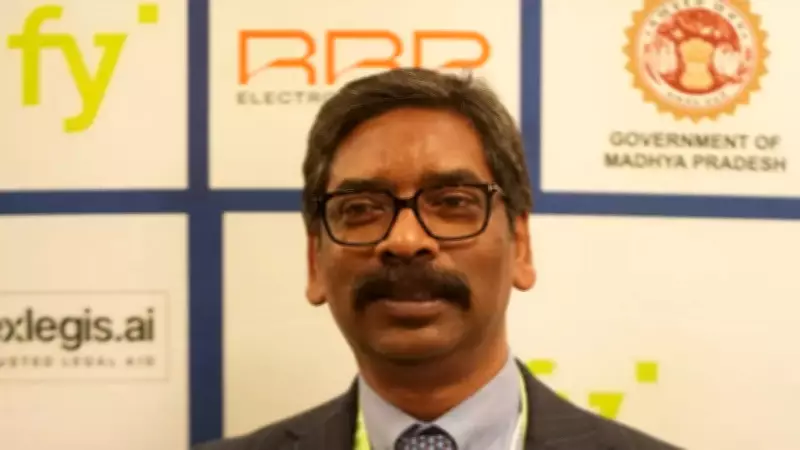
In a significant strategic shift away from its historical reliance on mineral resources, Jharkhand's top officials utilized the prestigious platform of the World Economic Forum 2026 to unveil a detailed and forward-looking investment roadmap. Chief Minister Hemant Soren and Finance Secretary Prashant Kumar, speaking at high-level sessions, articulated a clear vision for transitioning the state's economy toward capital efficiency, value-added manufacturing, and decentralized employment generation. This move signals Jharkhand's readiness to embrace a more diverse and resilient industrial future, marking a departure from its traditional identity as a mineral-dependent region.
Charting a New Economic Course
During a fireside address at ET House, Chief Minister Hemant Soren acknowledged that while Jharkhand's economic trajectory has long been anchored in its rich mineral endowment, the future demands a broader approach. "A new generation has emerged with different expectations," Soren stated. "There is a clear imperative to move beyond mere mineral extraction and explore substantial opportunities in processing, manufacturing, and the services sector." He emphasized that diversification, value addition, and future-facing industries are now central to the state's growth strategy.
Leveraging Legislative Changes and Energy Opportunities
Soren highlighted the policy space created by the Sustainable Harnessing and Advancement of Nuclear Energy for Transforming India (SHANTI) Act of 2025. He noted that this legislative framework opens new possibilities for Jharkhand in the nuclear energy domain. The central government already conducts uranium mining in the state, and the new act allows Jharkhand to evaluate opportunities aligned with India's evolving critical minerals and energy strategy, potentially positioning it as a key player in the national energy landscape.

Empowering MSMEs for Rapid Growth
Micro, small, and medium enterprises (MSMEs) are identified as a crucial pillar of Jharkhand's next phase of economic expansion. Soren described these enterprises as agile engines of development capable of delivering quicker turnaround times and faster employment generation compared to large, capital-intensive projects. "Small and medium industries operate with speed. They can commence operations rapidly and generate jobs almost immediately," he explained, underscoring the state's increasing focus on enabling and supporting such businesses to thrive.
Broadening the Development Horizon
Beyond industrial diversification, Soren outlined a comprehensive development agenda encompassing multiple sectors. Jharkhand is actively working to unlock its tourism potential by developing circuits that link religious destinations like Deoghar. Additionally, the state is exploring partnerships to enhance sports infrastructure. Referring to Jharkhand as a "green state with a strong sporting legacy," Soren pointed to icons such as former Indian cricket captain MS Dhoni and the state's contributions to the national women's hockey team. He expressed confidence in Jharkhand's potential to establish large, globally benchmarked sports academies.
Prioritizing Women-Led Growth and Social Empowerment
Women-led growth is another key priority for the state government. Soren mentioned that focused programs for women entrepreneurs are under assessment, building on strong participation in existing welfare and livelihood schemes. Defending the use of direct benefit transfers against criticism, he asserted that the state's approach is rooted in long-term empowerment. Initiatives such as the Maiya Samman Yojana and the Guruji Student Credit Card, which offers education loans of up to ₹15 lakh at concessional rates, are designed to equip individuals with the capacity to achieve self-reliance.

Innovative Financing Mechanisms for Infrastructure
Complementing the Chief Minister's vision, Finance Secretary Prashant Kumar, speaking at a separate panel, detailed the mechanisms through which Jharkhand plans to fund this ambitious growth phase. Kumar acknowledged that traditional infrastructure financing models, heavily dependent on budgetary grants and bank lending, are under strain. "Fiscal space is constrained, yet development needs remain substantial," he stated. To address this, Jharkhand has begun actively exploring blended finance structures and public-private partnerships to mobilize capital for infrastructure creation.
Risk Management and Policy Frameworks
The state is increasingly adopting contract models where upfront risks are borne by the government, while operational risks are transferred to private players. Kumar cited the solar energy sector as an example, where land and water are provided free of cost, along with a 25-year power purchase guarantee. "Once these risks are mitigated, investments naturally begin to align," he emphasized. Furthermore, Jharkhand is drafting a new policy on industrial parks and boosting investments in transportation and logistics hubs to enhance connectivity and efficiency.
Private Sector Perspectives on Investment Climate
Private sector voices on the panel underscored the critical importance of policy certainty for attracting investment. Mohammad Athar, Partner and Leader of Capital Projects and Infrastructure Development at PwC India, noted that private capital is willing to invest when there is clarity on demand and regulation. He highlighted land policy frameworks, including long-term fixed rental models, as a key lever for unlocking investment potential.
Saurabh Tripathi, Leader of the Global Financial Institutions Practice at BCG, stressed that infrastructure projects inherently carry policy risk. Certainty around land acquisition, taxation, and regulatory continuity over long planning horizons is essential to attracting capital, he explained. Foreign investors, in particular, seek mechanisms to de-risk "existential risks" that could derail projects in emerging markets. Tripathi also cautioned that frameworks alone are insufficient: "Creating the right environment does not automatically draw investors. States must actively market themselves and identify suitable investors."
Rebranding Jharkhand for Global Competitiveness
Ultimately, Jharkhand's presence at Davos 2026 represents a significant step in rebranding the state as a competitive destination for global capital. By balancing social welfare initiatives with aggressive industrial reforms and innovative fiscal management, the government aims to ensure that Jharkhand's future is defined not solely by its subterranean resources but by the entrepreneurial spirit and technological potential of its people. This holistic approach seeks to foster sustainable and inclusive growth, positioning Jharkhand as a model for economic transformation in India.