

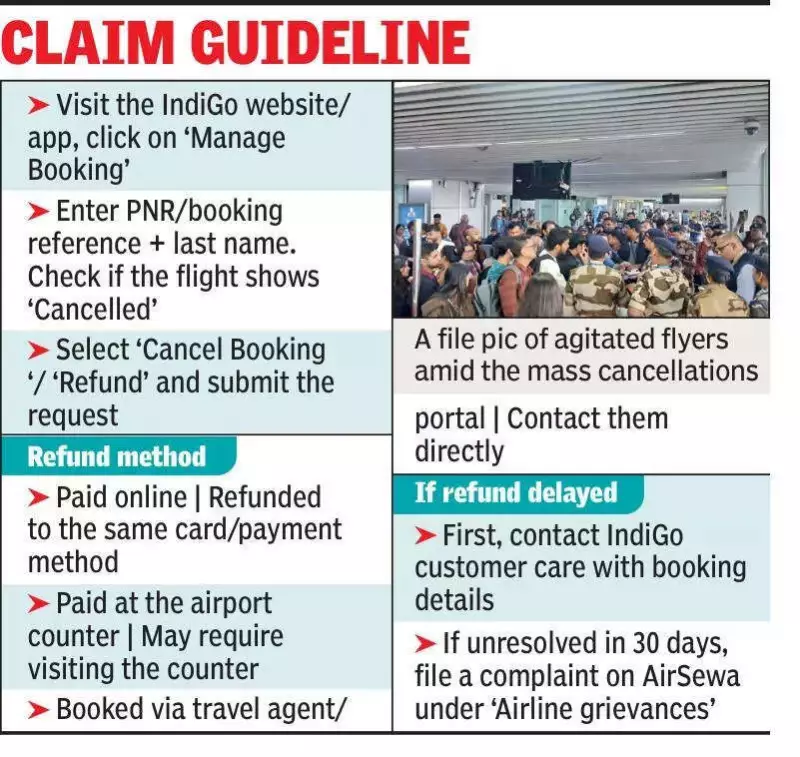
More than a month after a major operational disruption led to mass flight cancellations, numerous passengers of IndiGo are still struggling to receive their refunds. The airline maintains it has processed the payments, but travelers, especially those who booked through online travel agencies, report the money has not reached their bank accounts, leading to a wave of frustration and complaints.
The Core of the Refund Dispute
The crisis began in early December when IndiGo, along with other carriers, cancelled a significant number of flights due to crew shortages and operational issues. While the airlines promptly assured both regulators and customers that refunds for cancelled flights were being issued, the reality on the ground tells a different story for many.
IndiGo has consistently stated that refunds have been released to the original mode of payment, which includes bookings made via Online Travel Agencies (OTAs). However, the communication chain appears to have broken down, leaving passengers in the dark and out of pocket.

Passenger Anguish and Mounting Bills
Aggrieved flyers have taken to social media to voice their distress. A passenger named Subham highlighted his ordeal, tagging IndiGo, the Directorate General of Civil Aviation (DGCA), and the Ministry of Civil Aviation. He detailed how a flight booked from IXR to IXA via CCU on December 5 was disrupted, leaving him stranded in Kolkata (CCU) without assistance or a refund.
Another traveler, Soumya, expressed deeper frustration, stating, "36 days. That's how long IndiGo ignored me after cancelling my flight and leaving me with a 20k+ bill for extra stay and food." Soumya also mentioned that the airline is withholding not just the refund but also a compensation of Rs 10,000.
Some passengers have received only partial amounts. One flyer reported that both his flights on December 26 – IndiGo 6E2104 (Delhi-Kolkata) and the alternative 6E6836 – were cancelled. He received a partial refund of Rs 4,426 + Rs 196, but the remainder is still pending, a delay he finds unacceptable.
Why Refunds Get Stuck in the Pipeline
Industry experts clarify that the refund mechanism for tickets purchased through third-party platforms is inherently more complex than for direct bookings. When a flight is cancelled, the airline processes the refund to the travel portal or payment aggregator, not directly to the passenger's account. The intermediary entity is then responsible for transferring the funds back to the customer.
Anil Punjabi, Chairman (East) of the Travel Agents Federation of India (TAFI), provided crucial insight. He confirmed that IndiGo did disburse refunds to travel agents and portals, but often in the form of a 'credit shell' rather than direct cash. "It is the duty of the agent or the travel portal to pay the customers. Since the airline already refunded them the money as a credit shell, they can use it later to buy air tickets," Punjabi explained.
Further complications arise from standard banking settlement cycles. Refunds initiated via credit cards, UPI, net banking, or digital wallets can take anywhere from seven to 21 working days to reflect, depending on the bank and payment method. Additionally, reconciliation mismatches between airlines, payment gateways, and travel platforms can significantly slow down the entire process.
The Crucial Missing Link: Communication
Passengers cite a severe lack of transparent communication as a major factor adding to their distress. Abhishek Halder, who booked three tickets to Hyderabad in the first week of December and was forced to cancel them, summed up the common plea: "If there is a delay, tell us clearly where the money is stuck and how long it will take." This opacity leaves travelers feeling helpless and amplifies their frustration with the system.
The situation underscores a significant gap between policy and execution in crisis management within the aviation sector, particularly concerning third-party bookings. As passengers continue to wait, the call for clearer processes and more accountable communication grows louder.






