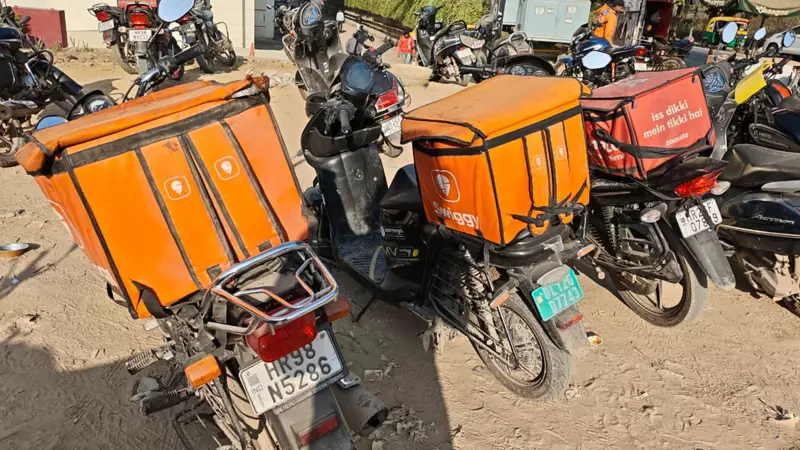
Quick commerce and food delivery platforms across the National Capital Region (NCR) are bracing for significant operational disruptions on New Year's Eve. This comes as unions representing delivery workers have called for a massive strike to demand pay transparency, an end to arbitrary ID blocking, and a crucial ban on the high-pressure 10-minute delivery model.
Unions Mobilize for Major Showdown
The strike, called for December 31, is spearheaded by the Telangana Gig and Platform Workers Union (TGPWU) and the Indian Federation of App-based Transport Workers (IFAT) from Karnataka. They are receiving backing from the Delhi-based Gig Workers Association (GiGWA). This follows a similar, albeit smaller, action on Christmas Day which impacted services in Gurgaon, Noida, and Ghaziabad during peak hours.
Shaik Salauddin, President of TGPWU, stated that while around 50,000 workers participated in the Christmas strike, the expectation for New Year's Eve is far greater. "We expect around 1.5 lakh workers to join the strike on Wednesday," he said. This is a substantial portion of the nation's gig workforce, which government estimates suggest crossed 1 crore (10 million) in the 2024-25 period.

Core Grievances: From Wage Opacity to Deadly Pressure
The workers' demands cut to the core of the gig economy's challenges. A primary issue is the lack of a transparent and stable pay structure. Nitesh Kumar Das, Organising Secretary of GiGWA, explained that pay is based solely on tasks completed, ignoring variables like waiting time, low demand, bad weather, and traffic. "Platforms change pay structures whenever they like, so workers don't know what their earnings will look like," he said.
Delivery partners report working grueling shifts of 13-15 hours daily, with incentives tied to nearly impossible targets. "If we work less than 13 hours or stop before 11.30 at night, there is a deduction in our daily incentive," shared Akaash, a delivery partner.
The most emotionally charged demand is for a ban on the 10-minute delivery model. Workers describe being forced to drive recklessly to meet punishing deadlines. "Even if we are late by a second for a delivery, our incentive for the entire day is taken away. We skip red lights and drive even when visibility is low," revealed a Blinkit delivery partner in East of Kailash. Salauddin framed the risk starkly: "Workers have been killed due to the constraints of the 10-minute delivery model. Who will be held responsible for their deaths?"
Businesses Worry, Workers Weigh Risks
The timing of the strike, on one of the year's busiest nights for food delivery, maximizes its impact. Pranav Rungta, Vice-President of the National Restaurants Association of India (NRAI), confirmed that business in Gurgaon was hit on December 25 and they are in touch with platforms. "The riders are smart, they know these dates will have the most impact," he noted, highlighting concerns over food wastage and lost revenue.
Customers, learning from the Christmas experience, have begun placing bulk orders in advance. Akshit Behl of Khadak Singh Da Dhaba said they are informing customers and arranging self-delivery for bulk orders, but admitted these cannot fully compensate for potential strike losses.
However, not every worker can afford to strike. Many live hand-to-mouth, with daily earnings of Rs 700-800 after 14-15 hours of work, which after expenses leaves little. "Strikes don't make much difference. I did not participate... because I can't afford a loss of pay and risk my ID getting terminated," confessed a Swiggy delivery partner. Some workers also reported intimidation during the previous strike, alleging that bouncers picked up individuals encouraging participation.
Platforms like Zomato have issued internal communications assuring that no partner will be stopped from working and that arrangements with local authorities are in place. Major companies including Zepto, Swiggy, Zomato, Amazon, and Uber did not respond to requests for comment on the strike and the underlying issues.

As New Year's Eve approaches, the standoff highlights the growing tension between the business models of quick commerce giants and the welfare of the massive, yet vulnerable, gig workforce that powers them.