

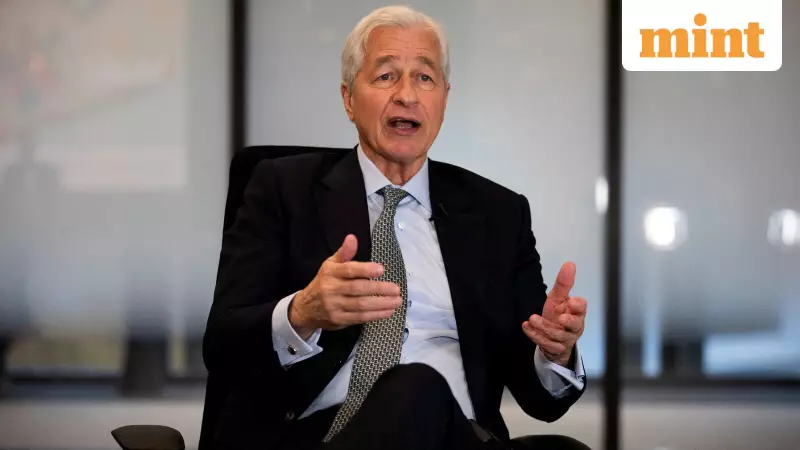
In the competitive world of global finance, one institution stands as a colossus: JPMorgan Chase & Co. Under the nearly two-decade leadership of CEO Jamie Dimon, the bank has grown to unprecedented size and efficiency, prompting a bold question from analysts: Could it become the world's first bank with a trillion-dollar market valuation?
The Unmatched Scale of a Banking Behemoth
Jamie Dimon, who will mark 20 years at the helm in January 2026, has built JPMorgan into a financial powerhouse. The bank's market capitalisation now stands at a staggering $730 billion, representing 30% of the total market cap of America's big banks—a dramatic rise from just 12% when Dimon took charge in early 2006.
Its dominance is visible across metrics. The bank holds a 12% share of all American deposits, double its share from years ago, and employs over 317,000 people. In 2021, it achieved a historic milestone by becoming the first lender with physical branches in all 48 contiguous US states, a coast-to-coast reach even its legendary predecessor, John Pierpont Morgan, never accomplished.

This immense scale creates a compounding advantage. With a vast deposit base of $2.5 trillion, JPMorgan enjoys cheap and stable funding. It outspends rivals on technology, allocating roughly $18 billion this year alone—about 40% more than Bank of America. Prominent analyst Mike Mayo of Wells Fargo has dubbed it the "Goliath of Goliaths" and the "Nvidia of banking," citing its ability to leverage AI and tech investments better than any competitor.
Efficiency, Competition, and the "Fortress" Balance Sheet
Size alone isn't the secret. JPMorgan combines its heft with remarkable efficiency. Its efficiency ratio—non-interest expenses as a share of revenue—has improved from 61% in 2015 to 51%, 15 percentage points lower than its closest competitor. This lean operation is something Dimon attributes to an athletic mindset, drawing inspiration from legends like Serena Williams and Tom Brady in their relentless pursuit of excellence.
The bank's competition now extends beyond traditional rivals. "We're competing against fintechs in payments and non-bank trading houses like Citadel Securities," says Troy Rohrbaugh, co-head of the commercial and investment bank. Internally, the bank has avoided becoming a siloed conglomerate. Mary Erdoes, head of wealth management since 2009, emphasises the importance of sewing different business pieces together seamlessly.
Dimon's famous "fortress" balance-sheet, characterised by large reserves and low leverage, provides crucial stability. It has allowed JPMorgan to act as a rescuer during crises, acquiring Bear Stearns and Washington Mutual in 2008 and, more recently, most assets of First Republic Bank during the 2023 regional banking turmoil. While these moves drew political criticism, Dimon is unapologetic, arguing that large banks provide vital heft to the American economy, moving $10 trillion daily and financing massive corporate deals.
The Daunting Challenges: Politics, Geopolitics, and Succession
JPMorgan's prominence makes it a political target from both the left and right. Its purchase of First Republic was attacked by an unlikely duo: left-wing Senator Elizabeth Warren and then-senator J.D. Vance. Regulatory caps also mean it cannot merge with another healthy lender due to its market share, though exceptions exist for failing institutions.
Geopolitical tensions add another layer of complexity. The bank recently faced congressional scrutiny for underwriting a share sale by Chinese battery giant CATL, a firm blacklisted by the Pentagon. Dimon notes that CATL isn't under US sanctions and advocates for continued commercial engagement with China, albeit acknowledging it will be "harder."
However, the most persistent question on Wall Street is succession. Dimon, who will turn 70 in March 2026, has stated he will step down as CEO in the next few years but remain chairman, refusing to give a precise timeline. Over a dozen potential successors have come and gone during his tenure. The current front-runners are four veteran lieutenants:

- Troy Rohrbaugh: Co-head of the commercial and investment bank (20 years at JPMorgan).
- Douglas Petno: Co-head of the commercial and investment bank (35-year veteran, recently promoted).
- Mary Erdoes: Head of Asset & Wealth Management (in role since 2009).
- Marianne Lake: CEO of Consumer & Community Banking.
Each is a loyal company veteran, and all downplay ambitions for the top job, focusing on their current roles. The challenge for any successor is immense: replacing a leader whose first-name recognition spans Wall Street and Capitol Hill, and who has personally shaped the bank's culture. Dimon himself has noted the unique weight of the CEO's crown, telling a former deputy that at the top, "there is nobody to complain to" and every decision carries ultimate responsibility.
As JPMorgan continues its expansion—growing its retail footprint in the US, launching digital banks in Britain and Germany, and deepening ties to the tech sector—the path to a trillion-dollar valuation seems plausible to bulls like Mike Mayo. Yet history offers a cautionary tale: Citigroup once held a similar 30% market-cap share before scandals and the 2008 crisis eroded its dominance. For JPMorgan, maintaining its scandal-light record, navigating political headwinds, and ultimately managing a leadership transition without losing its disciplined, competitive edge will determine whether it can claim that historic trillion-dollar title.





