

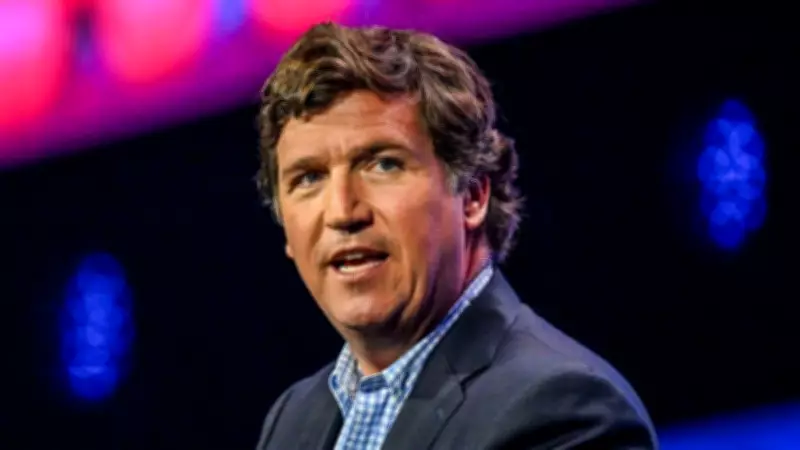
Tucker Carlson's Sharia Law Comments Ignite Political Firestorm
A viral segment from The Tucker Carlson Show has erupted into a major controversy after the prominent US commentator suggested that societies governed by Sharia law are "more advanced" than those in the Western world. The remarks, made during a recent episode, have drawn sharp criticism from conservative circles while Carlson's supporters have rushed to contextualize his statements.
Carlson's Controversial Comparison
In the contentious segment, Carlson painted a bleak picture of Western civilization, declaring: "There's not a single Western city that's thriving... They're all in moral and physical decay because of self-hatred and a lost will to live." He then made the provocative comparison that has since gone viral: "Sharia Law has made Islamic societies more advanced than the West."
Carlson elaborated on his perspective based on his travels throughout the Middle East, stating: "I travel a lot in the Middle East. It's amazing. They're Muslims. Countries governed by Sharia law. And you go there and it's incredible to be in a place that has pride in itself, that believes in its religion and culture, that thinks 'we're on to something.' That kind of self-confidence is what creates stability... and hospitality."

Conservative Backlash and Defense
The comments triggered immediate backlash, particularly from right-wing and MAGA-aligned voices. Activist Laura Loomer led the charge, accusing Carlson of "romanticising" jihadist societies and claiming his remarks supported her long-standing allegation that he had effectively "converted to Islam" or become a foreign-influenced "Qatarlson" figure.
Social media users amplified the criticism, arguing that Carlson was praising systems they believe suppress Christians and Jews while attacking fundamental Western values. The controversy has exposed deepening divisions within conservative circles over foreign policy, particularly regarding US involvement in the Middle East, support for Israel, and approaches to Iran.
However, Carlson's team and supporters have vigorously defended the commentator. They point to the full transcript of the episode, emphasizing that no quotes were fabricated and that Carlson never called for the United States to adopt Sharia law. Instead, they describe his remarks as observational commentary about why certain Gulf states—including Saudi Arabia, Qatar, and the United Arab Emirates—appear more stable and self-assured compared to Western capitals.
Carlson's defenders also stress that he has repeatedly described himself as a "fervent Christian" with no intention of converting to Islam. They contextualize the comments within broader discussions about cultural confidence and societal stability rather than as an endorsement of specific legal systems.
Broader Context and Recent Activities
The controversy emerges against a backdrop of Carlson's increasing engagement with Middle Eastern nations. Just a few months ago, the commentator visited Qatar for the Doha Forum, where he interviewed the country's prime minister. During that event, Carlson announced plans to purchase a home in Doha, explaining that he liked the city and was exercising his freedom as a "free man" to choose where to live.
This Middle Eastern connection has fueled speculation among critics about potential foreign influence, while supporters view it as evidence of Carlson's genuine interest in understanding different cultural perspectives. The timing is particularly sensitive given ongoing geopolitical tensions in the region, including conflicts involving Israel, Iran, and Gulf states.
The episode highlights growing fractures within American conservative thought regarding international relations, cultural values, and what constitutes national strength in an increasingly multipolar world.






