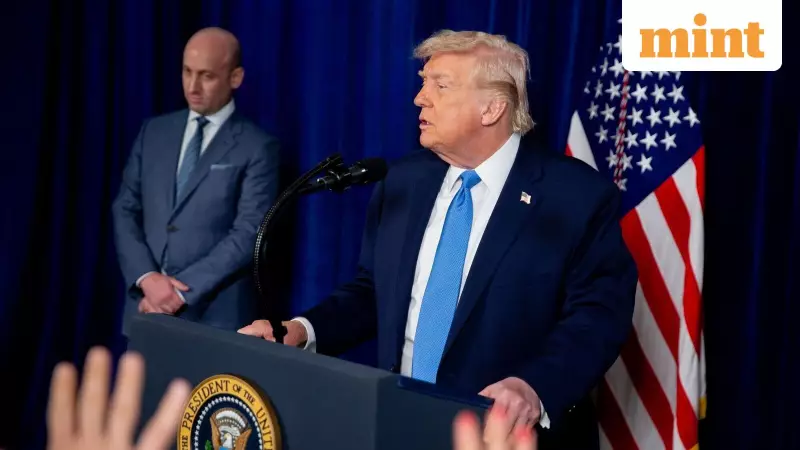
In a dramatic foreign policy shift, US President Donald Trump has committed the United States to an indefinite, open-ended nation-building project in Venezuela following a swift military operation that captured the country's strongman leader, Nicolás Maduro. The audacious move, announced from his Mar-a-Lago club in Florida on Saturday, January 3, 2026, marks a stunning reversal for a president who has long criticised his predecessors for similar overseas interventions.
The Operation and a Stark Policy Reversal
American forces executed a daring overnight raid, extracting Maduro and his wife, Cilia Flores, from a fortified compound in Caracas. They were flown by helicopter to a US Navy vessel in the Caribbean. Maduro now faces extradition to New York City to stand trial on drug-trafficking charges. While the operation itself echoed the targeted actions of Trump's second term, the subsequent announcement veered into uncharted territory.
President Trump declared that the US would essentially "run" Venezuela, a Latin American nation of 29 million people, for an unspecified period. "We're going to run it, essentially, until a proper transition takes place," he stated, providing scant details on the mechanics of governing without a massive troop presence, an option he did not rule out.

Challenges of Control and a Divided Response
The plan immediately faces monumental hurdles. Despite Maduro's capture, his top lieutenants—including powerful figures like Diosdado Cabello and Defence Minister Vladimir Padrino—remain in Venezuela, vowing defiance. Padrino asserted in a video message, "They have not broken us." Extending control beyond Caracas and managing a potential violent backlash will be a significant challenge for the Trump administration.
Trump framed the intervention as benevolent, aimed at helping ordinary Venezuelans and encouraging millions of exiles to return. A central pillar involves seizing Venezuela's oil industry to sharply increase production. He suggested wealth from this seizure would be shared between the Venezuelan people and the US as compensation for assets nationalised nearly two decades ago.
However, the move drew sharp criticism both domestically and raised questions about leadership. Trump cast doubt on opposition leader and Nobel Prize winner María Corina Machado, whom the US had previously supported, saying she lacked sufficient support. Instead, he indicated Secretary of State Marco Rubio had spoken to Vice President Delcy Rodríguez, who is next in line constitutionally.
Political reactions in the US were split. Outgoing Republican Representative Marjorie Taylor Greene criticised the engagement on social media, while Senate Minority Leader Chuck Schumer (D-N.Y.) warned, "The idea that Trump plans to now run Venezuela should strike fear in the hearts of all Americans."
Historical Echoes and an Uncertain Future
The situation draws uneasy parallels with past US interventions in Afghanistan and Iraq, which began with similar hopes of stability but resulted in prolonged conflict. While Trump allies have cited the 1989 Panama invasion as a model, Venezuela is more than twice the size of California with a 1,700-mile coastline and a loyal armed force of approximately 125,000 personnel, making it a far more complex undertaking.
With Maduro's regime remnants hunkering down and no clear roadmap for a stable transition, President Trump's gamble plunges the United States into a deep, costly, and unpredictable nation-building endeavour—a scenario he had vehemently denounced throughout his political career. The world now watches to see if this roll of the dice will pay off or become another chapter in the fraught history of foreign intervention.