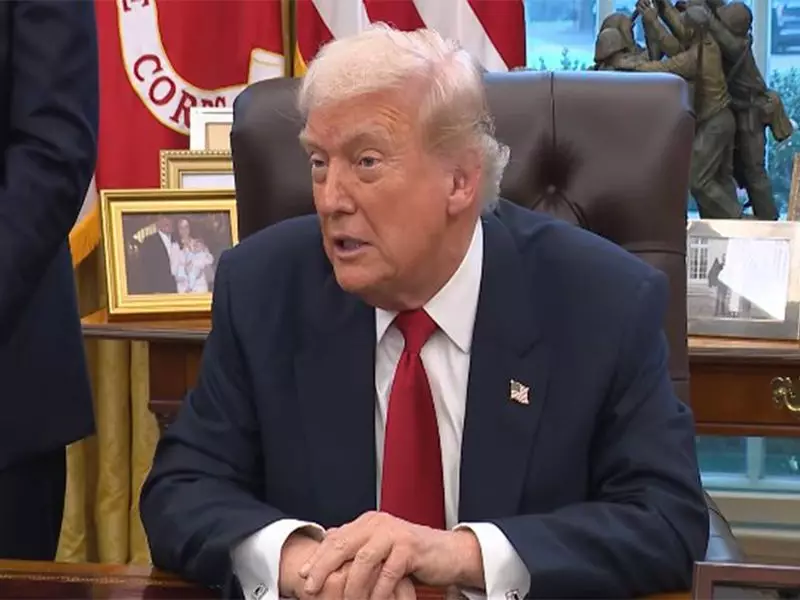
In a move that has sent shockwaves through the American political and legal landscape, former President Donald Trump has declared all documents signed by President Joe Biden using an autopen machine to be legally null and void. This sweeping declaration specifically targets a series of pardons issued by the current president, setting the stage for a profound constitutional confrontation.
The Core of Trump's Controversial Declaration
Donald Trump's statement, released via his official channels, directly challenges the validity of executive actions taken by his successor. The crux of his argument hinges on the use of the autopen, a mechanical device used to replicate a signature. Trump asserts that for a presidential pardon or any other official document to hold legal weight, it must bear the president's actual, physical signature.
The former president's proclamation explicitly states, "All Biden Autopen-signed documents, including pardons, are NULL and VOID." This bold claim does not merely question a procedural detail but seeks to invalidate the substance of the actions themselves. The use of autopens is not new in the White House; it has been employed by several modern presidents for routine documents, especially when they are traveling. However, applying this critique to instruments as powerful as pardons elevates the dispute to an unprecedented level.

Historical Context and Legal Ambiguity
The legality of autopen signatures has been a topic of periodic debate but has largely been accepted as a practical necessity of the modern presidency. Previous administrations, including those of George W. Bush and Barack Obama, have utilized the device. The Office of Legal Counsel (OLC) under the Department of Justice has issued opinions in the past supporting the use of autopens for certain presidential actions, arguing that it is the president's will and authorization that matters, not the physical act of putting pen to paper.
However, Trump's challenge forces a re-examination of this precedent, particularly for pardons. The presidential pardon power is one of the most absolute powers granted by the U.S. Constitution. By declaring these pardons "null and void," Trump is essentially arguing that a key constitutional power cannot be exercised via a surrogate mechanism. This creates immediate uncertainty for individuals who have received clemency through these means, potentially leaving their legal status in limbo.
Potential Ramifications and Political Fallout
The implications of this declaration are vast and complex. Legally, it invites immediate challenges in courts, where judges would have to rule on the validity of the autopen's use for core presidential functions. A ruling against the practice could force a radical change in how the executive branch operates, potentially invalidating not just pardons but also bills, orders, and appointments signed via autopen during Biden's tenure and possibly previous administrations.
Politically, this action is seen as a significant escalation in the ongoing rivalry between Trump and Biden. It frames Biden's administration as operating outside proper legal boundaries, a narrative that aligns with Trump's broader critique of his successor. The move energizes Trump's political base, which views it as a stand for constitutional purity, while Democrats and legal experts aligned with Biden are likely to dismiss it as a politically motivated stunt without legal merit.
The declaration also raises urgent questions about governance and the continuity of government. If the validity of a president's signature can be contested so fundamentally after the fact, it could lead to chronic instability and legal challenges to a wide array of government actions. It places the judiciary in the difficult position of having to define the very nature of a presidential signature in the digital age.
As the situation develops, all eyes will be on the White House's official response and whether any legal test cases emerge from individuals affected by the pardons in question. This controversy is more than a technicality; it is a direct challenge to established norms of presidential authority and promises to be a defining legal and political battle in the months to come.