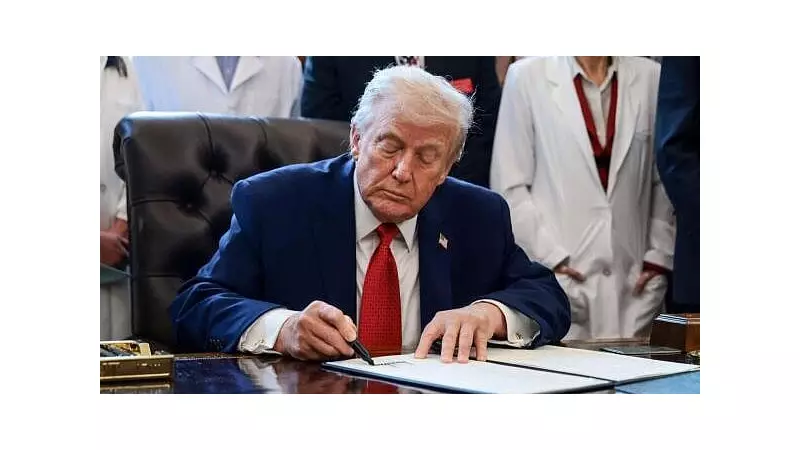
President Donald Trump is poised to enact a monumental piece of legislation, the annual defense policy bill, which authorizes a staggering $1 trillion in military spending for the United States. This move solidifies the Pentagon's budget and outlines key strategic priorities for the coming year.
Details of the National Defense Authorization Act
The legislation in question is the National Defense Authorization Act (NDAA) for the fiscal year 2021. The White House has confirmed that President Trump is expected to sign the bill into law imminently. This act is a critical piece of policy that not only allocates funds but also sets the overarching guidelines and restrictions for the Department of Defense.
While the specific, line-item details of the $1 trillion authorization were not fully elaborated in the initial report, the NDAA typically covers a vast range of military expenditures. These include soldier pay, procurement of new aircraft and naval vessels, funding for research into advanced technologies, and maintaining the country's nuclear arsenal. The passage of this bill is a routine yet crucial annual process for the U.S. military's operational planning and financial stability.

The Path to Presidential Approval
The defense bill has successfully navigated the legislative process, receiving approval from both chambers of the U.S. Congress. This bipartisan support underscores the bill's fundamental role in national security, even in a politically divided climate. The White House's announcement indicates the final step is merely a formality, with the President's signature being the last action required to enact the law.
The timing of the signing is significant, as it provides the military with a clear and authorized budget framework. This allows Pentagon officials and military commanders to proceed with confidence in their strategic initiatives, long-term procurement plans, and day-to-day operational funding without the uncertainty of a continuing resolution or a potential government shutdown affecting defense matters.
Strategic Implications and Global Context
The authorization of such a substantial defense budget carries considerable weight on the global stage. It signals the United States' continued commitment to maintaining a robust and technologically advanced military posture. The funds are likely to be directed toward countering strategic competitors, modernizing the nuclear triad, and investing in domains like cybersecurity, space, and artificial intelligence.
For allies and partners, including India, the sustained U.S. defense investment can be seen as a stabilizing factor in shared security interests, particularly in the Indo-Pacific region. Conversely, for adversaries, it represents a significant and enduring capability that must be accounted for in their own strategic calculations. The NDAA often includes specific provisions related to international partnerships and security cooperation, which can have direct and indirect effects on global defense dynamics.
In conclusion, President Trump's expected signing of the $1 trillion NDAA is a definitive action that locks in the financial and policy blueprint for the U.S. military for the next fiscal year. It reaffirms the primacy of defense spending in the national budget and sets the stage for the Pentagon's priorities in an increasingly complex international security environment.