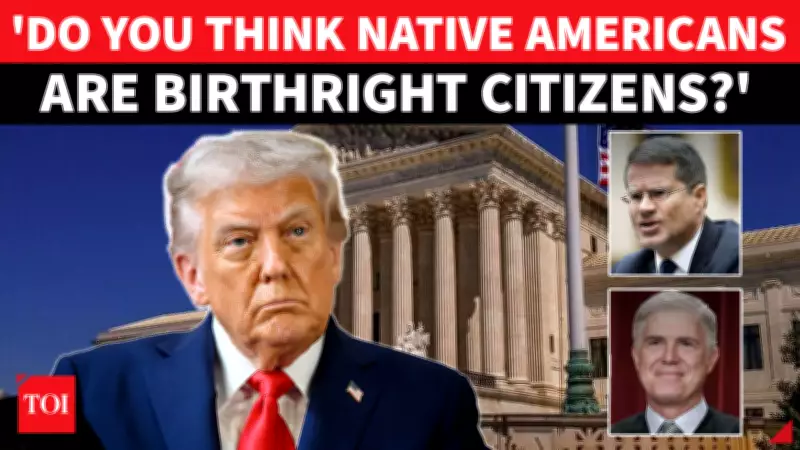
Tense Supreme Court Clash Over Birthright Citizenship and Native Americans
A dramatic and revealing exchange unfolded at the United States Supreme Court, where Solicitor General D. John Sauer, representing the Trump administration, faced intense and persistent questioning from Justice Neil Gorsuch. The focus of the interrogation was the complex and historically fraught issue of whether Native Americans are considered birthright citizens under the Constitution. This pivotal discussion occurred during oral arguments concerning a significant legal challenge to former President Donald Trump's controversial 2025 executive order, which aims to terminate the longstanding principle of birthright citizenship in the United States.
Legal Argument Unravels Under Judicial Scrutiny
Sauer initially attempted to anchor his argument in the Indian Citizenship Act of 1924, a federal statute that granted citizenship to Native Americans born within the territorial limits of the country. However, Justice Gorsuch, known for his sharp legal mind, pressed the lawyer to consider the constitutional framework independently, setting aside the 1924 statute. When compelled to do so, Sauer's position appeared to weaken significantly. He contended that historical congressional debates and legislative records suggest that children of tribal Native Americans were not originally viewed or classified as birthright citizens at the nation's founding or in the immediate decades that followed.
This admission highlighted a critical tension in the government's case. The solicitor general's reliance on legislative history, rather than a firm constitutional interpretation, seemed to leave him on uncertain ground, prompting moments of hesitation and the notable phrase "I'm not sure" in response to Gorsuch's probing questions. The justice's line of inquiry effectively exposed potential vulnerabilities in the administration's legal reasoning, emphasizing the deep and unresolved constitutional questions that lie at the very heart of this ongoing and high-stakes legal battle.

Broader Implications for Constitutional Law and Civil Rights
The exchange between Justice Gorsuch and Solicitor General Sauer transcends a mere courtroom debate; it underscores profound and enduring issues regarding citizenship, equality, and constitutional interpretation. Birthright citizenship, rooted in the Fourteenth Amendment, has been a cornerstone of American civil rights, ensuring that all persons born on U.S. soil are granted citizenship automatically. Trump's executive order seeks to upend this principle, arguing for a more restrictive interpretation that could exclude children of undocumented immigrants and, as this case reveals, potentially reignite questions about Native American status.
The focus on Native American rights adds a layer of historical and moral complexity to the proceedings. For centuries, Native American tribes have faced exclusion, displacement, and contested citizenship status. The 1924 Indian Citizenship Act was a legislative correction to past injustices, but as Gorsuch's questioning implied, its necessity might highlight original constitutional ambiguities or failures. This case forces the Supreme Court to grapple not only with the text of the Constitution but also with the nation's historical treatment of indigenous populations and the evolving understanding of citizenship.
Legal experts observing the arguments noted that Gorsuch's rigorous examination reflects the court's pivotal role in defining the boundaries of executive power and constitutional rights. The outcome of this case could set a monumental precedent, influencing immigration policy, civil rights law, and the interpretation of the Fourteenth Amendment for generations to come. As the legal battle continues, all eyes remain on the Supreme Court, awaiting a decision that will shape the very definition of what it means to be an American citizen.