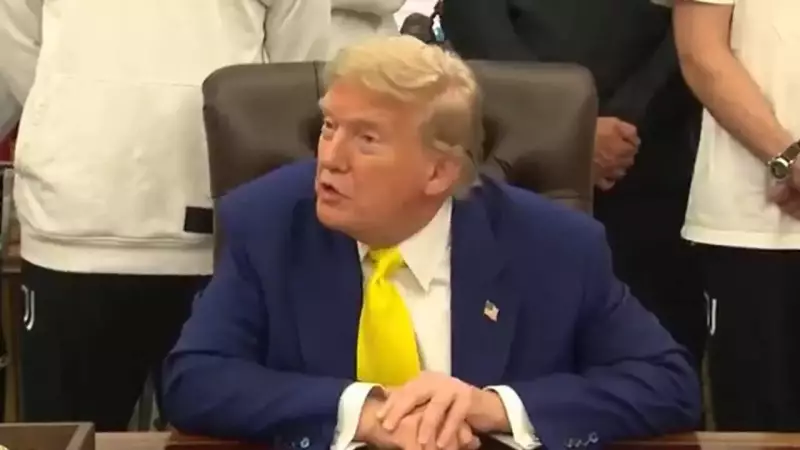
In a dramatic escalation of America's war on drugs, President Donald Trump has signed an executive order declaring the synthetic opioid fentanyl a weapon of mass destruction. The unprecedented move, made on Monday at the White House in Washington, fundamentally redefines the US government's approach to combating the drug blamed for tens of thousands of overdose deaths annually.
From Public Health Crisis to National Security Threat
The historic designation signals a pivotal shift in strategy. President Trump is now treating the fentanyl epidemic not just as a public health emergency but as a direct national security threat, comparable to chemical warfare. This reclassification grants the Pentagon and US intelligence agencies sweeping new powers. They can now assist domestic law enforcement and deploy counter-proliferation tools typically reserved for tracking nuclear or chemical weapons against international drug traffickers.
"We're formally classifying fentanyl as a weapon of mass destruction, which is what it is," President Trump stated during a White House event honouring military personnel deployed at the US-Mexico border. He accused adversaries of "trying to drug out our country." The official order explicitly states, "Illicit fentanyl is closer to a chemical weapon than a narcotic."

Military Strikes and Legal Controversies
This action builds on another controversial step taken earlier this year: designating powerful foreign drug cartels as foreign terrorist organisations. That move legally opened the door for direct military action. Since early September, the Trump administration has conducted more than 20 deadly strikes on suspected drug smuggling vessels in the Caribbean and Pacific, resulting in over 80 fatalities.
However, these aggressive tactics face significant legal and public scrutiny. Legal experts argue the strikes may be illegal, citing a lack of publicly available proof that the targeted boats were actually carrying narcotics or that destroying them was necessary instead of intercepting and seizing the cargo. Public opinion also shows resistance. A recent Reuters/Ipsos poll revealed broad American opposition to the military's campaign of deadly boat strikes, with nearly one-fifth of Trump's own Republican supporters expressing disapproval.
A Hemispheric Strategy and Global Supply Chain
President Trump has repeatedly threatened to extend these strikes to land targets in drug-producing and transit nations like Venezuela, Colombia, and Mexico. This aligns with a sweeping foreign policy strategy document released last week, which focuses on reasserting US dominance across the Western Hemisphere.
The fentanyl crisis has deep international roots. Mexico is identified as the primary source of illicit fentanyl entering the United States, while many of the precursor chemicals used to manufacture the drug are sourced from China. As a leading cause of overdose deaths in the US, the opioid's deadly toll provided the grim backdrop for this significant policy shift, merging the realms of public health, law enforcement, and military strategy into a single, formidable front.