

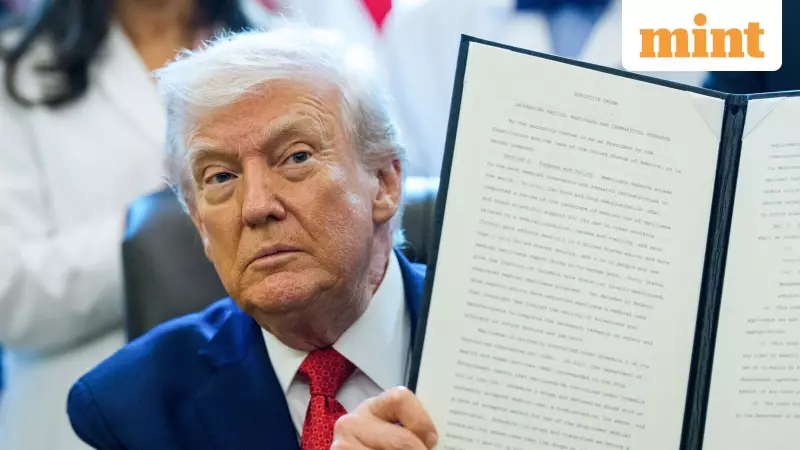
In a significant move for US drug policy, President Donald Trump on Thursday used his executive authority to push for faster reclassification of marijuana under federal law. The order aims to shift cannabis from its current status as a Schedule I substance to the less restrictive Schedule III category, primarily to facilitate enhanced medical research.
What the Executive Order Directs
The core directive of Trump's latest executive order is to instruct US Attorney General Pam Bondi to expedite the administrative process of rescheduling. This action seeks to conclude a initiative begun during the previous Joe Biden administration, which had stalled due to bureaucratic delays and legal challenges. Months into his second term, President Trump agreed to finalise the process.
The order explicitly criticises the federal government's historical stance, stating, "The Federal Government’s long delay in recognizing the medical use of marijuana does not serve the Americans who report health benefits from the medical use of marijuana to ease chronic pain and other various medically recognized ailments." It further establishes a clear administrative policy: "It is the policy of my Administration to increase medical marijuana and CBD research to better inform patients and doctors."

Legal Status and Industry Implications
President Trump was quick to clarify the scope of his action. During a press briefing from the Oval Office, he stressed, "I want to emphasize that the order I am about to sign is not the legalization or it doesn’t legalize marijuana in any way, shape or form, and in no way sanctions its use as a recreational drug." Under federal law, marijuana remains illegal, and penalties for recreational use are unaffected.
However, the eventual reclassification from Schedule I—where it currently sits alongside heroin and LSD, defined as having "no currently accepted medical use and a high potential for abuse"—to Schedule III—which includes drugs like Tylenol with codeine and ketamine, with "a moderate to low potential for dependence"—would have profound effects.
The most immediate impact would be on the cannabis industry's financial burden. Currently, businesses are hamstrung by IRS Code 280E, which bars them from deducting standard business expenses like rent, payroll, and marketing because they deal in a Schedule I substance. Reclassification would end this, allowing them to be taxed like normal corporations.
Analysts from Viridian Capital Advisors estimate that this change could save the top 12 cannabis companies alone approximately $800 million annually in taxes. These savings could potentially lead to lower prices for consumers if companies pass on the benefits. Furthermore, rescheduling would significantly ease restrictions on scientific research, paving the way for more FDA-approved cannabis-derived medicines and possibly future insurance coverage for medical marijuana prescriptions.
The Current Landscape and Federal Stance
The executive order does not alter the existing patchwork of state laws. Presently, 40 US states, plus Washington, D.C., have legalised medical marijuana, with 24 of those states also permitting recreational use. Despite this state-level acceptance, federal law under the Controlled Substances Act still prohibits marijuana, and companies require FDA approval to legally produce and distribute cannabis products. The order, as reported by TIME, does not change this fundamental federal prohibition.
In summary, while Trump's order stops short of federal legalisation, it is a decisive step toward recognising marijuana's medical potential and could catalyse major economic and scientific advancements in the field once the rescheduling is complete.






