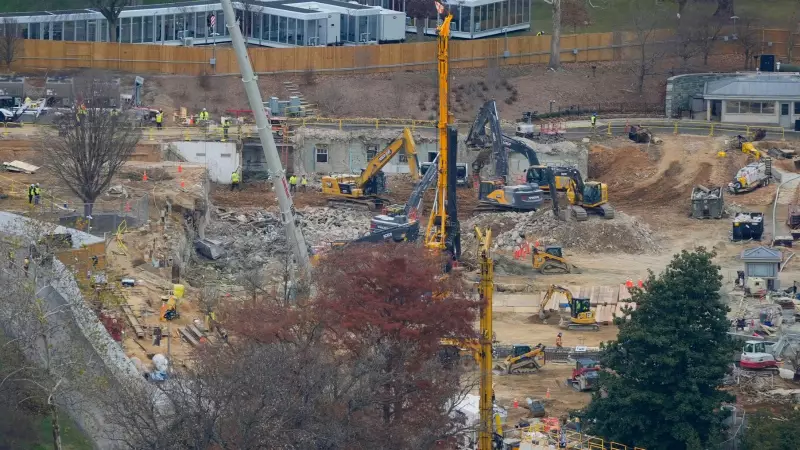
The administration of former US President Donald Trump has invoked a rarely used national security exemption to push forward with a controversial construction project inside the White House. The work involves building a new ballroom at the presidential residence, a plan that has now been shielded from standard environmental and historical reviews by citing urgent security needs.
The National Security Justification
In a formal filing to a federal court, lawyers representing the Trump administration made a striking argument. They stated that the proposed construction of the ballroom within the White House complex is intrinsically tied to the conduct of American diplomacy and national security. The administration's legal team contended that the space is essential for hosting foreign dignitaries and conducting high-level meetings, framing any delay as a direct threat to the nation's security interests.
This legal maneuver was deployed in response to a lawsuit. The suit was filed by the nonprofit watchdog group, Protect Democracy, alongside the National Security Counselors group. The plaintiffs had challenged the administration's decision to bypass standard review processes under the National Environmental Policy Act (NEPA) and the National Historic Preservation Act.

Bypassing Standard Reviews
Typically, any significant construction project on federal property, especially one as historically sensitive as the White House, must undergo thorough environmental and historical impact assessments. These reviews are designed to protect culturally significant sites and ensure environmental responsibility.
However, the Trump administration sought an exemption. The General Services Administration (GSA), the federal agency managing the project, utilized a provision that allows such reviews to be waived for projects deemed necessary for national security. In its court submission, the administration argued that the special circumstances of the White House as the President's home and workplace justify this exceptional treatment.
The filing emphasized the unique status of the White House, suggesting that the usual rules applied to other federal buildings should not constrain projects within its walls when security and diplomatic functions are at stake.
Legal Challenges and Broader Implications
The lawsuit from Protect Democracy argues that the administration's use of the national security exemption is an abuse of power and sets a dangerous precedent. Critics fear it could allow any politically convenient construction project on federal land to avoid scrutiny simply by attaching a national security label to it.
This case highlights a recurring tension during the Trump presidency: the expansion of executive power and the use of national security arguments to sidestep legal and regulatory hurdles. The ballroom project, while seemingly aesthetic, has become a legal battleground over the limits of presidential authority and the integrity of long-standing federal protections for the environment and historical heritage.
The court's eventual decision will have significant ramifications. It will determine whether the national security exemption can be applied so broadly to a construction project with clear ceremonial and personal use, or if the administration must subject the White House ballroom plans to the same level of review required for any other major federal undertaking.