

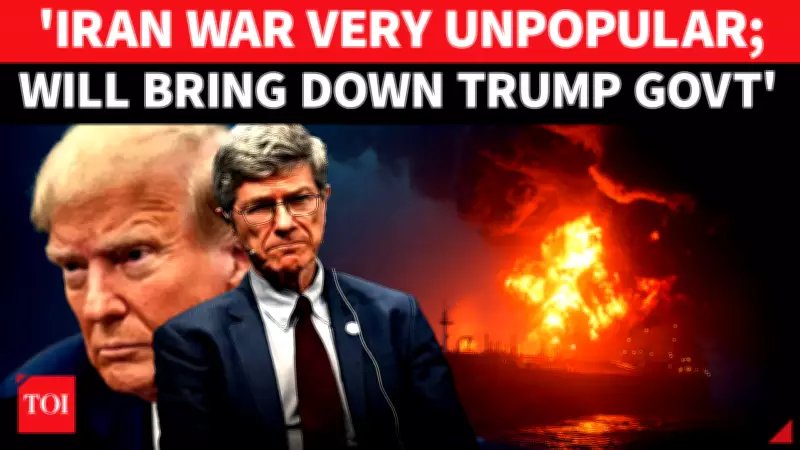
Jeffrey Sachs Forecasts American Backlash Against 'Israel-Controlled' US Administration
Prominent economist Jeffrey Sachs has issued a stark warning about the future of American governance, predicting that citizens will ultimately bring down what he describes as an "Israel-controlled" regime under Donald Trump. In a comprehensive analysis of the ongoing Iran conflict, Sachs characterizes the military engagement as a dangerous "joint venture" between the United States and Israel that prioritizes leadership ambitions over strategic necessity.
Direct Criticism of Trump and Netanyahu Leadership
Sachs specifically targets both Donald Trump and Israeli Prime Minister Benjamin Netanyahu in his critique, attributing the conflict to what he calls "megalomania" at the highest levels of government. The economist argues that institutional checks and balances within the United States government have effectively ceased to function, creating a situation where executive decisions face minimal oversight or resistance.
The analysis connects current developments to historical patterns of American intervention in Iran, particularly referencing the 1953 coup that overthrew Prime Minister Mohammad Mosaddegh. According to Sachs, Washington continues to approach the Middle East with a mindset focused on control and influence rather than genuine diplomacy or regional stability.

Broader Geopolitical Context and Regional Resilience
Sachs expands his examination beyond the immediate Iran conflict to encompass global strategic dynamics. He suggests that United States foreign policy operates across multiple theaters simultaneously, with alliances like NATO serving broader geopolitical objectives in Europe and Asia. Despite this extensive military and diplomatic apparatus, Sachs emphasizes that Iran has demonstrated remarkable resilience throughout the conflict.
The economist contends that the current military approach is unlikely to produce a decisive victory for either side, instead forecasting prolonged instability with significant costs accumulating for all involved parties. This assessment challenges conventional narratives about military superiority and quick resolutions to complex regional conflicts.
Institutional Failure and Public Backlash Predictions
A central theme in Sachs' analysis is the breakdown of governmental institutions that traditionally provide oversight and balance in American foreign policy. He warns that this institutional failure creates conditions where leadership decisions go largely unchallenged, potentially leading to escalations that might otherwise be avoided through proper checks and balances.
The most striking prediction involves Sachs' forecast of eventual public backlash against what he perceives as excessive Israeli influence over American policy. He suggests that American citizens will ultimately recognize and reject this dynamic, potentially leading to significant political consequences for the current administration and its approach to Middle Eastern affairs.
Historical Parallels and Contemporary Implications
Sachs draws explicit connections between current policies and historical American interventions, arguing that patterns established decades ago continue to shape contemporary approaches to Iran and the broader Middle East. This historical perspective provides context for understanding what he views as persistent American tendencies toward interventionism and control in the region.
The analysis concludes with a sober assessment of the conflict's trajectory, emphasizing the human and material costs already incurred and predicting further instability regardless of short-term tactical outcomes. Sachs' comprehensive critique presents a challenging perspective on American foreign policy and its relationship with key allies in the current geopolitical landscape.






