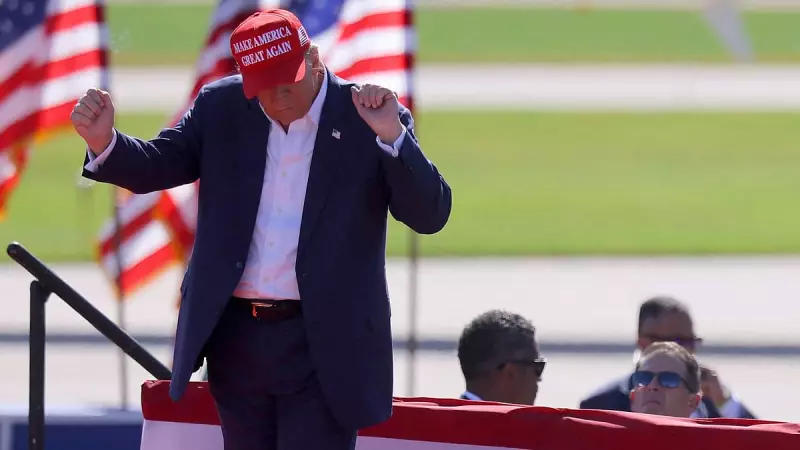
In a significant statement, the United States Secretary of State, Marco Rubio, has credited former President Donald Trump for pursuing "very dangerous" peace agreements, explicitly mentioning efforts between India and Pakistan. The remarks were made during a Cabinet meeting at the White House on Tuesday, December 2, 2025.
A New Doctrine for American Foreign Policy
Rubio articulated a fundamental shift in the guiding principles of US diplomacy. He stated that for the first time in decades, American foreign policy is now being directed by a single, clear-cut criterion: whether an action or alliance makes the United States "safer, stronger and more prosperous." This marks a departure from what he implied were more complex or ideologically driven approaches of the past.
The Secretary of State positioned this pragmatic doctrine as the core of the current administration's strategy on the global stage. The focus, according to his statement, is squarely on tangible outcomes that benefit American security and economic interests above all other considerations.

Trump's Legacy in High-Stakes Diplomacy
While discussing this results-oriented approach, Rubio pointed to the diplomatic ventures of the previous Trump administration as prime examples. He specifically highlighted the pursuit of peace deals in volatile regions, describing them as "very dangerous" undertakings due to their complexity and high stakes.
The India-Pakistan relationship was cited as a key instance where such Trump-era diplomacy was applied. Although a formal, comprehensive peace deal was not finalized, the period saw intense diplomatic engagement and moments of reduced tensions, which Rubio now credits to Trump's willingness to engage in high-risk diplomacy aligned with the stated goal of enhancing US security and influence.
Implications for Regional and Global Politics
Rubio's comments are likely to be analyzed closely in diplomatic circles, particularly in South Asia. By publicly acknowledging the Trump administration's role in India-Pakistan peace efforts, he is reinforcing a continuity in the US's interest in stabilizing the region, albeit under a strict framework of American benefit.
This framing suggests that future US mediation or involvement in longstanding conflicts, whether between India and Pakistan or elsewhere, will be rigorously evaluated through the lens of this new doctrine. The statement reinforces that the current US leadership views strategic diplomacy not as an altruistic endeavor but as a tool for national advantage.
The Cabinet meeting on Tuesday, therefore, served as a platform to cement a clear, if controversial, foreign policy vision—one that praises past risky initiatives while charting a firmly interest-driven course for the future.