

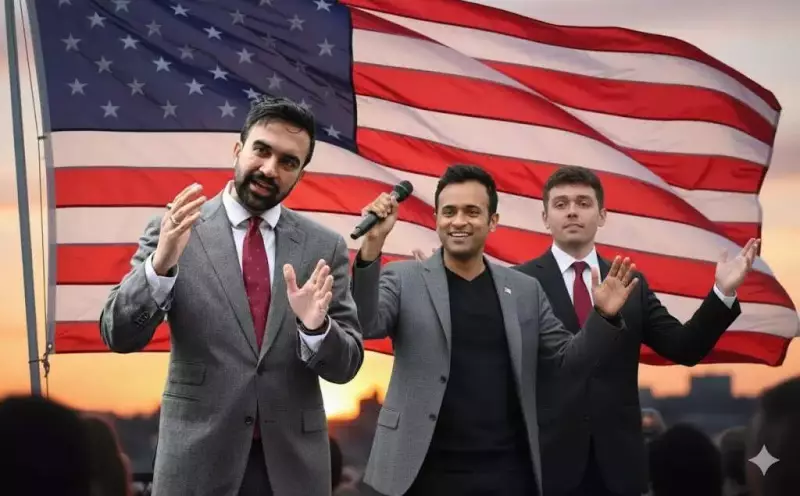
The fierce culture wars in the United States have evolved beyond mere policy disagreements. At their core, they now grapple with a fundamental question of belonging: Who is truly American? Defining the rules of entry and the very essence of national identity has become the central, combustible debate. Enter Vivek Ramaswamy, the Indian-origin Republican, former presidential candidate, and conservative voice, who has stepped into this fray with a provocative essay for The New York Times.
The Pincer Movement on American Identity
Ramaswamy presents a stark diagnosis of the current national divide. He frames it as a pincer movement squeezing the traditional concept of American identity from two extremes. On the right, he identifies the rise of "groyperism"—a movement that roots Americanness in ancestry, race, and heritage. In this worldview, legitimacy stems from "blood and soil," privileging those whose family histories predate modern immigration and social change.
On the left, Ramaswamy perceives a different but equally damaging force. He uses the term "Zohran Mamdani-infused socialism" as shorthand for an ideology that defines identity through grievance, class struggle, and group membership. Here, politics centers on race, victimhood, and redistribution. Ramaswamy argues that despite different aesthetics, both sides drive toward the same outcome: the fragmentation of the nation.

Civic Creed Over Bloodline: The Radical Conservative Idea
At the heart of Ramaswamy's argument is a classically conservative yet currently radical proposition: Americanness is binary. You are either American or you are not. There are no gradations based on skin colour, lineage, or date of arrival. His definition is rooted in civic belief. An American is someone who subscribes to the Constitution, the rule of law, freedom of speech and conscience, and pledges exclusive allegiance to the United States.
This vision, drawing from the Reaganite tradition, posits that citizenship, not lineage, is the sole qualifying test. America's unique strength, he contends, is that anyone from anywhere can become a full part of the nation by embracing its civic creed. This openness is not a modern deviation but the original point of the American experiment.
Personal Experience Sharpens the Political Argument
Ramaswamy's intervention carries particular weight due to his personal journey. Born and raised in Ohio to Indian immigrant parents, he has spent his entire life in the US. Yet, his rise in Republican politics has been marred by racial abuse. He has been subjected to slurs, told to "go back to India," and dismissed as un-American—primarily because he is not white. His wife has also faced demeaning ethnic targeting from far-right commentators.
For Ramaswamy, this is not abstract. It is proof that segments of the right are drifting into the very identity politics they claim to oppose. In rejecting race-based narratives from the left, he argues, some conservatives have inadvertently embraced a racial narrative of their own, creating a politics of identity under different flags.
The Prescription: Beyond Diagnosis to National Renewal
Ramaswamy does not stop at critique. He offers a prescription for national renewal. This includes moral clarity against racism and antisemitism, economic reforms to restore faith in the American dream, broader participation in wealth creation, and a unifying national project ambitious enough to reignite shared belief. Underpinning all this is one central idea: America cannot function as a civilization if it defines itself by who belongs less. It only works if it defines itself by what its people believe together.

The significance of his New York Times essay lies not in settling the argument, but in exposing the fault lines from within conservative circles. A conservative leader of Indian origin warning his own side against racial nationalism marks a notable moment. His vision rejects both progressive multiculturalism and reactionary ethno-nationalism. It is a demanding, civic ideal that forgives neither bloodline politics nor grievance politics. In Vivek Ramaswamy's formulation, America is not an inheritance; it is a choice. And the nation must now decide if it still believes that.





