

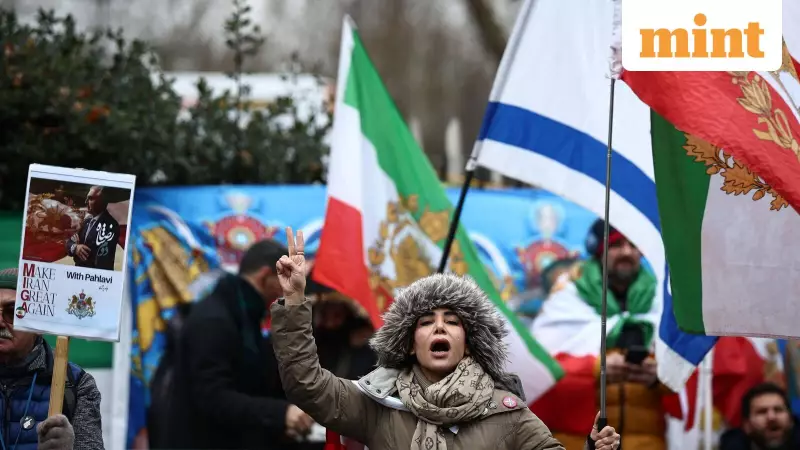
A wave of unprecedented anti-government demonstrations has gripped Iran, marking the most significant challenge to the Islamic Republic's authority in decades. According to seasoned observers, the scale of the unrest now surpasses the 2009 protests and rivals the upheaval that toppled the Shah in 1979.
A Nationwide Uprising Takes Shape
What began as scattered demonstrations on December 28th rapidly escalated over twelve days. By January 9th, crowds swelling to many thousands had taken to the streets. The protests, which ignited in provincial towns and villages, quickly spread to Iran's major urban centres, affecting all 31 provinces of the country.
The demographic of the protesters has notably widened. Women, the middle-aged, and the middle class—groups that had previously remained largely on the sidelines—have now joined the ranks of young and unemployed men. In Tehran, the capital, hundreds of thousands were heard chanting "death to the dictator", a direct reference to the 86-year-old Supreme Leader, Ayatollah Ali Khamenei.

Reports from the capital detail protesters setting fire to mosques, seminaries, banks, and police stations. The movement's strength was evident in Mashhad, Iran's second city and a traditional stronghold for regime hardliners, where crowds grew so vast that former US President Donald Trump declared on social media that the people had taken control. A cleric with ties to the regime described the situation as "a turning point."
The Regime's Hardline Response and Deepening Crises
Facing this formidable challenge, Ayatollah Khamenei has chosen to double down. In a speech on January 9th, he refused to differentiate between protesters with legitimate grievances and rioters, labelling all as stooges of Donald Trump. The authorities responded by throttling internet access, a move often seen as a prelude to harsher repression.
Human rights groups report that over 40 people have been killed and more than 2,000 arrested. Some hardliners within the regime argue that an even higher toll is necessary to restore fear and clear the streets of what they call "terrorists." However, the regime's capacity for brute force is constrained by a profound loss of domestic confidence and a crippled international position.
At home, Iranians have lost faith in their rulers' ability to manage a spiralling cost-of-living crisis. President Masoud Pezeshkian has himself admitted to the severity of the economic collapse. Shortages of electricity and water are now compounded by food scarcity, with basic imports failing to reach provinces. The rial's rapid devaluation has led shopkeepers to hoard goods. Over the past 15 years, some 15 million people have slipped from the middle class into the working class, with about 30% of Iranians now living in poverty.
External Pressures and a Symbolic Figurehead
The regime's weakened stature abroad has further convinced many Iranians that its end is near. Israeli military campaigns have degraded Iran's regional proxies and, in a 12-day air strike campaign last summer, eliminated much of Iran's senior military command. Khamenei, wary for his personal safety, is reported to spend long periods in hiding.
Meanwhile, Donald Trump's revived "maximum pressure" policy has throttled oil exports and squeezed revenue repatriation. His threat that Khamenei would "pay hell" for lethal repression acts as another constraint. Adding to the pressure, pro-regime media circulated (unverified) reports of the US deploying the 101st Airborne Division to Iraqi Kurdistan on Iran's border.

For the first time since 2009, a significant portion of the protest movement has rallied behind a single opposition figure. Massive crowds poured onto the streets shortly after Reza Pahlavi, the 65-year-old son of the last Shah, called for mass action from his home in Washington on January 6th. While some remain committed royalists, many others see him as a symbol of desperation. As a Tehran teacher who scrawls anti-Khamenei slogans put it, "We know he's a clown, but no other opposition figure has his brand recognition." This unity is not universal, however, with protesters in Kurdish and Azeri areas rejecting both Khamenei and the Shah.
Internal Cracks and an Uncertain Future
Publicly, the regime shows no signs of cracking. The silence from within is so profound that a businessman close to the establishment suggested reformers inside have "guns to their heads." Yet, murmurs of dissent have surfaced in closed online forums used by insiders. In some towns, security forces have been filmed beating a retreat, raising questions about how long the various security apparatuses will prioritise Khamenei's safety over their own.
After 36 years in power, Khamenei appears tired and short of ideas. On the eve of the protests, some even whispered about a "Bonaparte"—a strongman from the Islamic Revolutionary Guard Corps—taking charge. The Supreme Leader shows no inclination to step aside or seek exile. A former acquaintance notes, "He belongs to a revolutionary generation... For them the best death is martyrdom. He would rather fight than resign."
The ultimate outcome now hinges on a simple, brutal contest: who possesses greater staying power—Iran's ageing ruler, or its desperate and determined people?





