India and Slovakia on Monday announced 14 key outcomes during Prime Minister Narendra Modi's State Visit to Slovakia, including the elevation of bilateral ties to a Comprehensive Partnership, the establishment of a Joint Working Group on Counter Terrorism, and agreements in areas ranging from defence and labour mobility to digital technologies and scientific cooperation.
Comprehensive Partnership Established
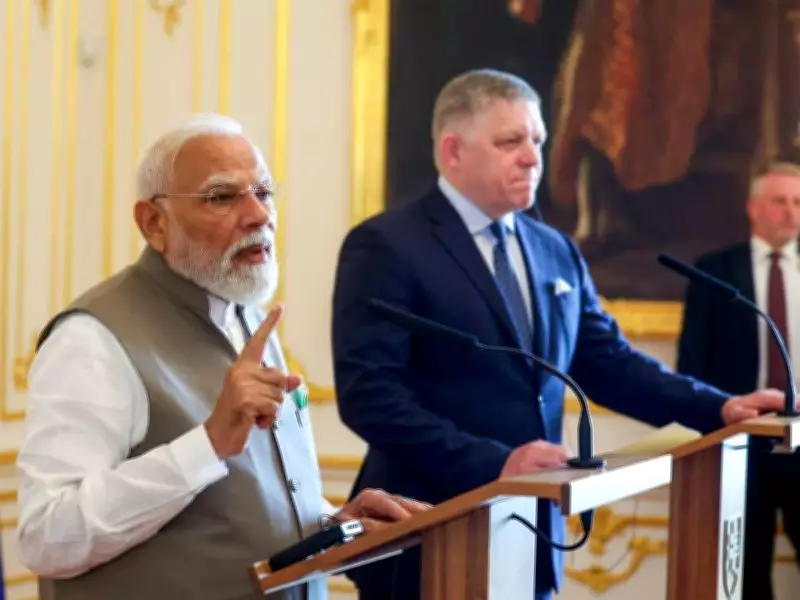
Among the major announcements, the two countries agreed to elevate their bilateral relationship to a Comprehensive Partnership, reflecting the growing depth and strategic nature of India-Slovakia ties. PM Modi described this elevation as a "very special moment" for bilateral ties, highlighting growing cooperation across sectors such as technology, manufacturing, culture, and people-to-people exchanges. The announcement came after Prime Minister Narendra Modi's "excellent meeting" with Slovak Prime Minister Robert Fico in Bratislava, underscoring the untapped potential of the partnership.
Key Agreements and MoUs
According to a statement by the Ministry of External Affairs (MEA), the two sides also announced the establishment of a Joint Working Group on Counter Terrorism and agreed to launch a Consular Dialogue mechanism to strengthen cooperation in consular matters. In the area of mobility and defence, India and Slovakia signed an MoU on cooperation in the field of Labour Migration aimed at facilitating the movement of professionals and skilled workers, along with a Letter of Intent promoting cooperation in the defence field to advance joint development, joint production, and collaboration between defence industries.

The visit also resulted in the signing of several Memorandums of Understanding and agreements across diverse sectors. These included an MoU on Digital Technologies, an MoU on cooperation in Higher Education and Research, and an MoU on Audio-visual Creation. The two countries also announced the establishment of the first-ever Indian Council for Cultural Relations (ICCR) Chair in Artificial Intelligence at the Technical University of Kosice. Another significant outcome was the signing of a Memorandum of Understanding in the field of Quantum Communication and Critical Infrastructure Protection, reflecting the growing focus on emerging technologies.
Health, Education, and Tourism Cooperation
In the health sector, the National Institute of Naturopathy, Pune, under the Ministry of Ayush, signed an MoU with Slovak Health Spa Piestany to enhance cooperation in wellness and traditional systems of healthcare. Academic collaboration was further strengthened through an agreement between the Indian Institute of Technology (IIT) Delhi and the Slovak Technical University covering student exchange programmes, scholarships, and research cooperation. The two sides also expanded cooperation in tourism through an agreement between tour operators' associations from both countries. Scientific collaboration received a boost with the signing of an Agreement on Scientific Cooperation between the Indian National Science Academy (INSA) and the Slovak Academy of Sciences (SAS).
PM Modi's Remarks and Engagements
In a series of posts on X following his engagements, PM Modi said that his discussions with Slovak Prime Minister Fico focused on expanding cooperation in several sectors, including automobiles, railways, advanced manufacturing, and green technology. "Our talks covered cooperation in sectors like automobiles, railways, advanced manufacturing and green technology. The India-EU Free Trade Agreement will also add momentum to our partnership," he said. Emphasizing the role of innovation in bilateral ties, PM Modi described technology as a key pillar of the India-Slovakia partnership. "We view technology as a key pillar of the India-Slovakia partnership. The MoU on digital technology will open many new areas of cooperation. We will also work closely in AI and space," he stated.

During his visit, PM Modi, accompanied by Prime Minister Fico, laid a wreath at the Tomb of the Unknown Soldier in Bratislava to honour Slovak soldiers who sacrificed their lives for the country's freedom. The MEA said the two leaders reviewed the full spectrum of bilateral relations and explored new avenues of cooperation in trade and investment, defence and security, technology and innovation, space and nuclear energy, education and culture, and talent mobility and people-to-people exchanges. The MEA also noted that the leaders exchanged views on regional and global issues, including reforms of the United Nations, and agreed to elevate India-Slovakia ties to a Comprehensive Partnership. "The meeting resulted in several outcomes including in the areas of digital tech, defence, cybersecurity, post-quantum technologies, audio-visual creation, mobility, scientific cooperation including nuclear," the MEA said in a post on X.
PM Modi also met Slovak President Peter Pellegrini at the Presidential Palace in Bratislava, where both leaders welcomed the growing partnership between the two countries. According to the MEA, the leaders discussed expanding cooperation in digitalisation, innovation, defence, space, nuclear energy, and education, while reaffirming their commitment to advancing the warm and friendly ties between India and Slovakia.
Cultural and Business Engagements
Reflecting on the cultural dimension of the visit, PM Modi highlighted the popularity of Indian traditions abroad. "It is gladdening to see Indian art and culture become popular globally," he said, referring to a collection of paintings created by Slovak children inspired by the Panchatantra and Jataka tales. "Drawing inspiration from the Panchatantra and Jataka tales, the artworks beautifully showcase how India's ancient wisdom and traditions continue to resonate with younger generations around the world," the Prime Minister added. At the Presidential Palace, PM Modi and President Pellegrini also viewed a painting exhibition dedicated to the theme "Varanasi City". According to the MEA, the exhibition featured artworks by Slovak artists that captured the spiritual and cultural essence of one of India's oldest living cities. "The artworks also included paintings by Slovak artists who visited Varanasi recently and were inspired by its unique ambience and traditions," the MEA said, adding that both leaders appreciated the exhibition as a reflection of the role of art in strengthening cultural ties.
PM Modi also participated in an interaction hosted by Prime Minister Fico with prominent Slovak business leaders, where discussions centred on investment, innovation, and manufacturing partnerships. "Had insightful discussions on strengthening economic ties, boosting investment flows and expanding collaboration in innovation, technology, manufacturing and more. Highlighted India's reform trajectory and growing opportunities and invited Slovak companies to deepen their partnership with India," PM Modi said.
Historic Visit
The Prime Minister's visit to Slovakia marked the first-ever visit by an Indian Prime Minister to the country since its independence in 1993 and culminated in a broad expansion of bilateral engagement across strategic, economic, technological, and cultural domains.