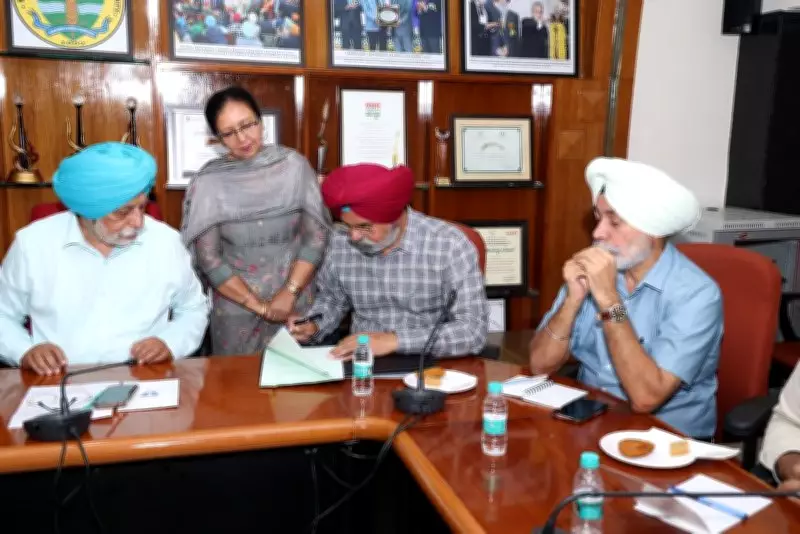
In a significant advancement for weather intelligence and climate-resilient agriculture in Punjab, Punjab Agricultural University (PAU), Ludhiana, has signed a memorandum of understanding (MoU) with the India Meteorological Department (IMD). The agreement was finalized during a high-level meeting chaired by PAU Vice-Chancellor Satbir Singh Gosal.
Key Signatories and Participants
The MoU was formally signed by Makhan Singh Bhullar, Director of Extension Education at PAU, and Surender Paul, Director of IMD Chandigarh. Senior university officials, including Registrar Rishi Pal Singh and Director Ajmer Singh Dhatt, were present during the signing ceremony.
Objectives of the Collaboration
The primary goal of this partnership is to strengthen Punjab's weather observation and forecasting infrastructure. This will be achieved through the installation of a doppler weather radar and a network of advanced meteorological observatories across the state. The initiative is expected to provide real-time data that will enhance weather-based advisories and support the development of AI-driven solutions for agriculture.

Doppler Weather Radar Installation
Speaking about the radar, Surender Paul noted that it is being installed under the Government of India's Mission Mausam Scheme. The C-Band doppler weather radar will be located at the Krishi Vigyan Kendra (KVK) in Nag Kalan, Amritsar. It will have the capability to track weather systems up to 300 kilometers away, significantly improving the forecasting of western disturbances and other weather events that impact Punjab. This system will not only aid in better policy decisions but also enhance public safety through timely weather alerts.
Ground Observatories Network
Makhan Singh Bhullar elaborated on the second component of the project: the establishment of nine ground meteorological observatories. These will be set up at KVKs in Amritsar, Pathankot, Fatehgarh Sahib, Hoshiarpur, Sangrur, Mansa, and Muktsar, as well as at research stations in Abohar and Kapurthala. This expanded network will bolster weather surveillance across Punjab and improve early warning systems for farmers and other stakeholders.
Impact on Agriculture
PAU Vice-Chancellor Satbir Singh Gosal hailed the initiative as a game changer for Punjab's agricultural sector. He emphasized that weather variability remains a decisive factor in crop productivity and farm planning. The installation of the radar at KVK Nag Kalan will significantly strengthen the monitoring and forecasting of weather systems across northwest India. Real-time data from the new observatories will enrich the state's observational network and accelerate the development of weather-based advisories.
Expert Views
P.K. Kingra, head of the Department of Climate Change and Agricultural Meteorology at PAU, described the MoU as a significant step toward strengthening Punjab's weather intelligence network. She highlighted the growing need for robust forecast and observation systems in the face of increasing climate variability and extreme weather events.
Conclusion
The collaboration between PAU and IMD marks a major leap forward in weather intelligence and climate-ready agriculture in Punjab. With the installation of advanced radar and observatories, the state is poised to enhance its capacity for accurate weather forecasting, ultimately benefiting farmers and contributing to agricultural resilience.