

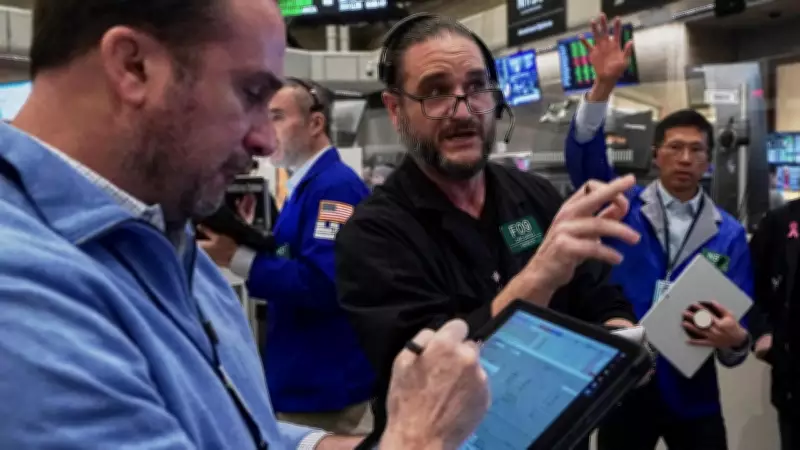
US Stocks Retreat as Middle East Tensions Dampen Market Optimism
US stock markets experienced a downturn on Tuesday, relinquishing a significant portion of the gains achieved in the prior session. This shift occurred as renewed military actions in the Middle East, including airstrikes on Iran and missile attacks targeting Israel, eroded the fleeting optimism that had briefly buoyed investor sentiment. The S&P 500 index fell by 0.6%, nearly erasing half of its previous day's advance. Meanwhile, the Dow Jones Industrial Average dropped 363 points, equivalent to a 0.8% decline, and the Nasdaq Composite decreased by 0.5%.
Oil Prices Surge Amid Persistent Geopolitical Strains
Oil prices climbed sharply, reflecting the escalating tensions in the region. Brent crude oil surged by 3.5% to reach $103.47 per barrel, a notable recovery after having plummeted over 10% in the preceding session. Benchmark US crude also saw gains, rising by $2.20 to trade at $90.33 per barrel. In early trading, Brent added $1.47 to hit $101.41, as reported by the Associated Press. The volatility in oil markets underscores the sensitivity of energy prices to geopolitical developments, particularly conflicts that threaten key shipping routes like the Strait of Hormuz.
Market Volatility Intensifies with Continued Military Actions
Financial markets remained highly volatile as military engagements persisted. Airstrikes targeted Iran's capital, while Iranian missiles and drones were launched at Tel Aviv and other locations across the Middle East. The deployment of additional US Marines to the Gulf region and sustained barrages from both sides fueled concerns about a potential escalation of the conflict, weighing heavily on investor confidence. These developments followed statements from US President Donald Trump, who indicated progress in talks with Iran to end hostilities and extended a deadline for Tehran to reopen the Strait of Hormuz. However, Iran denied any negotiations had taken place, with parliament speaker Mohammad Bagher Qalibaf dismissing such reports as "fakenews" aimed at manipulating financial and oil markets.

Global Markets Display Mixed Reactions
International markets showed divergent trends in response to the ongoing crisis. In Europe, France's CAC 40 index rose by 0.4% to 7,759.97 during early trade, and Germany's DAX edged up 0.2% to 22,695.54. Britain's FTSE 100 remained largely unchanged at 9,899.12. Conversely, Asian equities staged a robust rebound. Japan's Nikkei 225 gained 1.4% to close at 52,252.28, recovering from earlier losses, while South Korea's Kospi surged 2.7% to 5,553.92. Hong Kong's Hang Seng jumped 2.8% to 25,063.71, and China's Shanghai Composite added 1.8% to end at 3,881.28. Australia's S&P/ASX 200 increased by 0.2% to 8,379.40.
Corporate Developments and Future Market Outlook
In corporate news, Estee Lauder and Spanish cosmetics firm Puig confirmed they are engaged in merger discussions, potentially combining brands such as MAC, Clinique, Charlotte Tilbury, and Apivita. Estee Lauder clarified that no final decision has been made, with its shares showing minimal movement in premarket trading. Separately, Toyota Motor Corp. announced a $1 billion investment in its Kentucky and Indiana plants, leading to a 0.6% rise in its shares. This initiative is part of a broader $10 billion investment plan in the US over the next five years, highlighting Japanese manufacturers' efforts to bolster American employment and economic growth.
Analysts remain cautious, noting that while there are tentative signs of progress toward a ceasefire, the path to peace is long and uncertain. Michael Brown, a senior research strategist at Pepperstone, commented, "Still, while there's clearly a long way to go until some sort of ceasefire is agreed, and peace restored, we do at least seem to have taken the first step towards those ends." Markets are expected to stay sensitive to geopolitical developments, with investors closely monitoring ceasefire prospects, energy supply disruptions, and oil price movements in the coming sessions.






