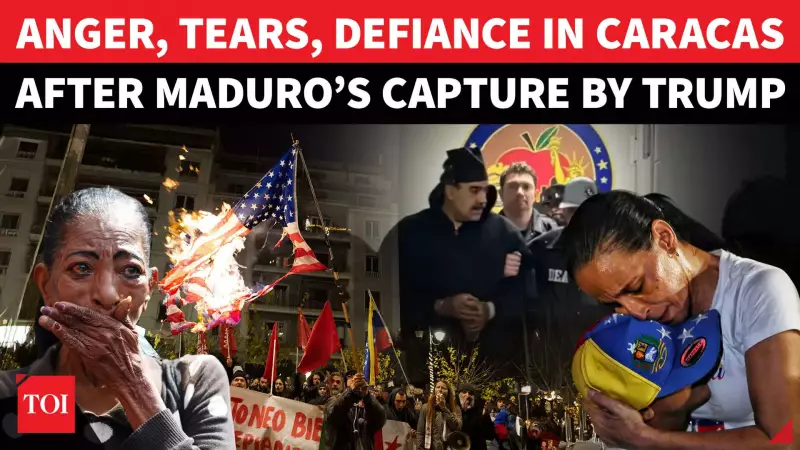
The political landscape of Venezuela was thrown into unprecedented chaos on January 4, 2026, following the dramatic capture of President Nicolás Maduro by United States forces. The operation, which has sent shockwaves across the globe, triggered an immediate and volatile eruption of mass protests in the capital city of Caracas, with citizens flooding the streets in a mix of celebration and outrage.
A Nation Divided: Celebration and Outrage on Caracas Streets
The streets of Caracas became the epicentre of Venezuela's deep political divide. Supporters of the captured president, Maduro, poured into public squares, demanding his immediate release and condemning the US military action as a blatantly illegal violation of their country's sovereignty. Chants against the United States and President Trump echoed through the city, reflecting a profound sense of national humiliation and anger.
Conversely, voices from the opposition and citizens weary from years of severe economic and humanitarian crisis expressed a cautious sense of hope. For them, the event, however controversial, represented a potential turning point after a prolonged period of hardship and political stalemate under Maduro's rule. The nation is now gripped by a potent cocktail of fear, uncertainty, and a fierce battle over its future direction.

The Operation and Its Immediate Fallout
Details emerging from the operation, reportedly codenamed 'Op Absolute Resolve', suggest a large-scale military undertaking. Reports indicate the involvement of approximately 150 American aircraft, with the core action unfolding over a remarkably short, intense period. The captured Venezuelan leader was swiftly transported to the United States, where footage showed an FBI-escorted, handcuffed Maduro reportedly giving a thumbs-up gesture at a DEA office.
In a related and provocative development, a video has surfaced claiming to show a Venezuelan missile striking a US helicopter during the operation, with President Trump himself reportedly acknowledging a 'pretty bad' hit. Meanwhile, in the power vacuum created in Caracas, Delcy Rodríguez has reportedly assumed control, becoming the new presiding authority in Venezuela in the absence of a clear successor to Maduro.
International Repercussions and the Oil Question
The international reaction has been swift and severe, setting the stage for a major geopolitical confrontation. Key allies of the Maduro regime, namely China and Russia, have issued strong statements, accusing the US of crossing red lines and promising retaliation. This move threatens to escalate into a broader international crisis.
At the heart of the tension lies Venezuela's vast oil reserves. Statements attributed to Trump about 'claiming control' over Venezuela and its oil have fueled fears that the operation was motivated by resource acquisition. This allegation has intensified the debate, with critics framing the action as an illegal war for oil rather than a mission for democracy or justice. The world now watches anxiously as Venezuela, a nation already on its knees, becomes the focal point of a dangerous new struggle for influence and control.