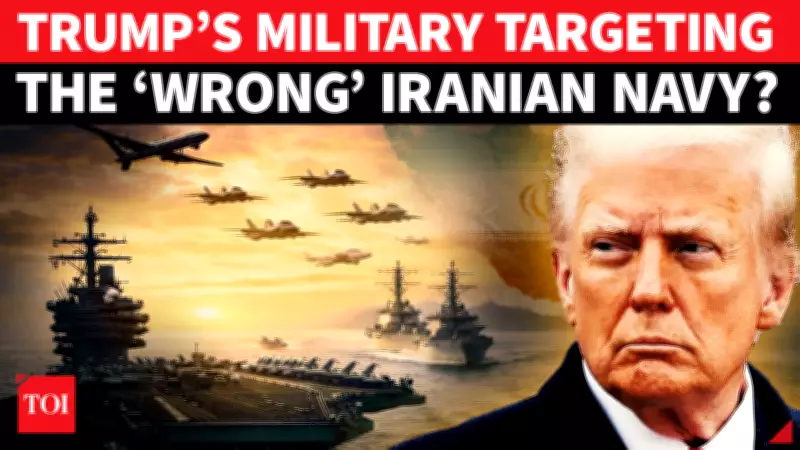
US-Israel Strikes Cripple Iranian Navy, But IRGC's Secret Fleet Still Menaces Hormuz
In a significant escalation of regional tensions, coordinated military strikes by the United States and Israel have delivered a major blow to Iran's conventional naval forces. According to satellite analysis cited by The New York Times, the attacks have destroyed several Iranian warships and inflicted substantial damage on key naval installations.
Conventional Fleet Suffers Heavy Losses
The primary target of these strikes appears to have been the Islamic Republic of Iran Navy, the country's official and conventional maritime force. Military analysts report that this fleet has sustained significant losses, potentially degrading its ability to project power in a traditional naval confrontation. The destruction of vessels and bases represents a tangible setback for Iran's military capabilities in the Persian Gulf region.
The Persistent Threat of the IRGC Navy
Despite these successful strikes against conventional assets, security experts are sounding the alarm about a far more elusive and dangerous adversary: the naval arm of the Islamic Revolutionary Guard Corps. Often described as Iran's 'secret' or asymmetric navy, the IRGC Navy operates on a fundamentally different doctrine.

This force does not rely on large, expensive warships. Instead, its strategy is built around swarm tactics using:
- Fast-attack speedboats capable of harassing much larger vessels.
- Advanced maritime drones for surveillance and potential strikes.
- Unmanned explosive vessels designed to overwhelm defenses.
This asymmetric approach is specifically tailored for the narrow, congested waters of the Strait of Hormuz, a global oil transit chokepoint.
Strait of Hormuz: A Critical Flashpoint
The strategic importance of the Strait of Hormuz cannot be overstated. It is a vital artery for global energy supplies, with a significant portion of the world's seaborne oil passing through its narrow confines. Analysts warn that even with a diminished conventional navy, Iran retains the capacity, through the IRGC, to disrupt commercial shipping and threaten this crucial route.
The recent strikes, while impactful, have not eliminated this latent threat. The IRGC's decentralized and agile forces, which are harder to target in pre-emptive strikes, could still execute harassment campaigns, mine-laying operations, or other actions that would have immediate and severe consequences for global energy markets and regional stability.
The situation underscores the complex, two-tiered nature of Iran's maritime power and the ongoing geopolitical tensions that continue to simmer in the Middle East. The confrontation between Iran and the US-Israel alliance remains a pivotal issue with direct implications for international trade and security.