Ukraine's Four-Year War: A Testament to Unyielding Resilience
While global headlines pivot toward escalating tensions in West Asia, Ukraine quietly marks the grim fourth anniversary of Russia's full-scale invasion. The conflict that former U.S. President Donald Trump once predicted would end swiftly has instead become a protracted struggle, filled with painful ironies and profound lessons for the world.
The Haunting Echo of Iranian Drones
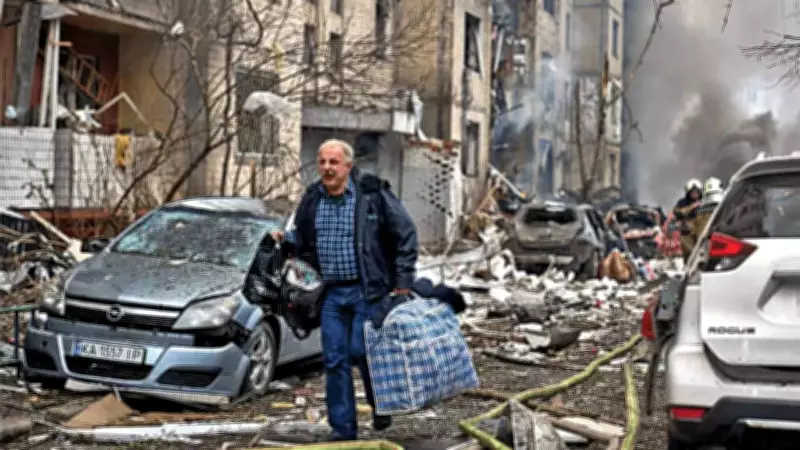
As residents across Saudi Arabia and the United Arab Emirates now scan night skies for Iranian drones and missiles, Ukrainians watch with bitter recognition. For four years, Iranian-designed Shahed drones—supplied to Russia and rebranded for Moscow's war machine—have terrorized Ukrainian cities with their unmistakable low, mechanical buzz.
These drones are not merely weapons but psychological torture instruments, designed to exhaust air defense systems and erode civilian morale through systematic attacks on energy plants, residential buildings, and critical infrastructure. The same ominous hum that now unsettles Gulf residents has become a familiar soundtrack to Ukrainian nights.

Winter as a Weapon and the Battle for Normalcy
Ukraine recently endured its harshest winter in 16 years, with temperatures plunging to -20°C. Russia strategically targeted the country's energy infrastructure during this period, creating widespread blackouts that transformed daily survival into a battlefield of improvisation.
"We live by outage schedules," explained Yevhen, a Kyiv-based entrepreneur. "When electricity comes—maybe four hours—we charge everything: phones, laptops, portable heaters, power banks." Across Ukrainian cities, cafes advertise "generator power," restaurants install diesel backups, and families cluster around single heated rooms in what has become ordinary survival.
Cultural Resurgence Amidst Conflict
The war has triggered a remarkable revival of Ukrainian language and culture as a form of resistance. Bookstores report surging demand for Ukrainian authors, parents insist their children speak Ukrainian at home, and theater productions sell out despite regular air raid sirens.
At the Kyiv Gymnasium of Oriental Languages No. 1, middle school students recently gathered to commemorate poet Lesya Ukrainka, who first translated the Rig Veda into Ukrainian. Their serious recitations and curiosity about India—asking about Bollywood and Goa's beaches—demonstrate how normal teenage interests persist even as their nights are fractured by war.
The European Dimension of Ukraine's Struggle
Ukrainian businessman Victor Pinchuk describes the conflict as "a great European, hybrid war" happening on Ukrainian territory but with continental implications. He characterizes Russia as a totalitarian empire animated by perpetual grievance—"a sense of injustice that regenerates itself."
Former Lithuanian Prime Minister Ingrida Šimonyte echoes this perspective, noting that Baltic states warned about Russian aggression for years while being called paranoid. "Now we are living this nightmare," she stated, emphasizing how Putin's red lines have repeatedly shifted.
Territory, Dignity, and the Unacceptable Price of Surrender
Crimean Tatar MP Tamila Tasheva speaks with measured intensity about Ukraine's position: "All of us hope for a ceasefire, but the biggest issue is territory." Russia's demand that Ukraine relinquish the Donbas region is unacceptable because, as she insists, "They don't just want Donbas. They want to destroy Ukraine."
Opinion polls show that even after four devastating years, a large majority of Ukrainians refuse to surrender Crimea or the Donbas. "For us, the most important thing is dignity," Tasheva explained. "Too many of our soldiers have died defending this land. We cannot just give it up."
Nuclear Blackmail and the Zaporizhzhia Threat
Europe's largest nuclear facility, the Zaporizhzhia Nuclear Power Plant, represents one of the conflict's most terrifying dimensions. Seized by Russian forces early in the invasion and converted into a military base, the plant now operates under dangerous conditions with compromised cooling systems and reduced qualified staff.

Dmytro Orlov, mayor of Enerhodar, warns that the facility contains almost ten times more nuclear material than Chornobyl. With approximately 1,000 Russian troops stationed on site, the plant serves as both shield and threat—with potential consequences extending far beyond Ukraine's borders if fighting intensifies.
Redefining Resistance Through Everyday Acts
Across Ukraine, resistance takes diverse forms beyond military engagement:
- The Helmet of Remembrance: Skeleton racer Vladyslav Heraskevych refused to compete at the MilanoCortina Winter Olympics without his tribute helmet honoring Ukrainian athletes killed in the invasion, stating: "Ukrainian athletes are willing to give up the Olympics for our flag and principles."
- Language as Identity: Football in Ukraine has seen players carded for speaking Russian during matches, reflecting how four years of war have brought language politics to the forefront of national identity.
- Points of Invincibility: During the harsh winter, these heated centers—stocked with food, power banks, and water—became symbols of community resilience against Russia's energy infrastructure attacks.
- Artistic Defiance: In frontline cities like Kherson, artists like Iryna create beautiful Ukrainian embroidery despite personal tragedy, responding to war's ugliness with beauty.
- International Solidarity: Japanese national Fuminori Tsuchiko, in his 70s, runs a free café and library in Kharkiv through crowdfunding, serving hundreds daily and providing children with wartime normality.
Between Hope and Weariness: The Ukrainian Mood
On trains from Kyiv to Poland—the wartime lifelines of Ukrzaliznytsia railway—young Ukrainians express gratitude mixed with skepticism about international promises of support "for as long as it takes." After four years of funerals and destruction, that phrase inspires impatience alongside appreciation.
As one computer science student studying in Warsaw asked about Indian perceptions of Ukraine: "Do Indians know we have a separate history from Russia?" Her subsequent comment—"We will see"—captures the prevailing Ukrainian mood: grateful, tired, determined, and cautiously hopeful.
Ukrainians do not celebrate fear as drones now buzz over other world regions, but they recognize its sound intimately. They have lived beneath it for four years, through winter cold, blackouts, funerals, and nuclear threats. They remain standing not because they are unbreakable, but because they believe surrender would break something far more essential than buildings: their dignity. And that, they have decisively concluded, is not negotiable.