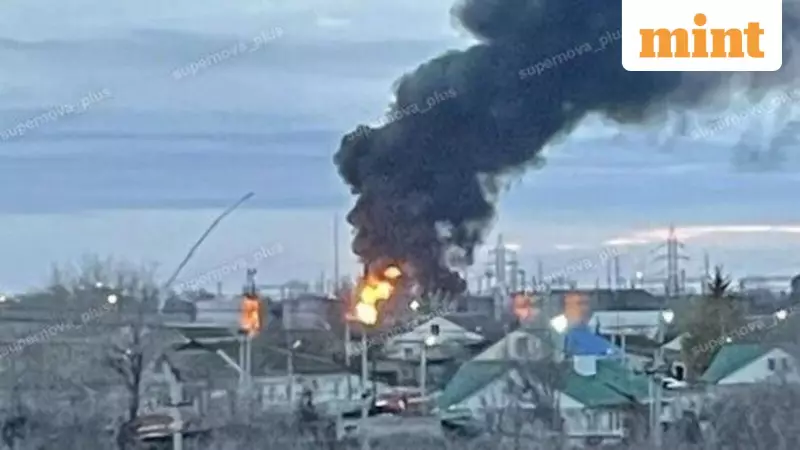
A Ukrainian drone attack successfully targeted and ignited a major oil storage facility in Russia's southern Volgograd region on Saturday. This strike comes as a direct response to a massive Russian aerial assault a day earlier, which included the rare use of a nuclear-capable hypersonic missile and severely crippled Ukraine's power and heating systems.
Escalation in Volgograd and Kyiv
The governor of the Volgograd region, Andrei Bocharov, confirmed the incident on Telegram, stating there were no immediate reports of casualties. However, he indicated that residents living near the Zhutovskaya oil depot might need to be evacuated as a precaution. Ukraine's General Staff openly claimed responsibility for the overnight operation, asserting that the depot was a crucial fuel supply point for Russian military forces. Assessments of the damage are currently ongoing.
This attack is part of Kyiv's broader strategy to use long-range drones to hit Russian energy hubs. The goal is twofold: to disrupt military logistics and to erode Moscow's oil export revenue, which finances its war effort. On the other side, Russia continues to target Ukraine's civilian energy infrastructure in a tactic Ukrainian officials condemn as "weaponizing winter," aiming to deprive people of light, heat, and water.

Russia's Hypersonic Missile Warning
The drone strike on Volgograd followed a devastating Russian barrage on Friday. That attack involved hundreds of drones and dozens of missiles, killing at least four people in Kyiv. Crucially, Moscow deployed its advanced, nuclear-capable Oreshnik hypersonic missile for only the second time in the nearly four-year-long war, striking western Ukraine in what analysts see as a stark warning to NATO allies supporting Kyiv.
Stéphane Dujarric, spokesman for the UN Secretary-General, expressed grave concern, stating Friday's attacks "have resulted in significant civilian casualties and deprived millions of Ukrainians of essential services, including electricity, heating and water at a time of acute humanitarian need."
Reciprocal Strikes and Recovery Efforts
Amid the destruction, Ukrainian Prime Minister Yulia Svyrydenko announced that heat supplies would be fully restored to the capital, Kyiv, by Saturday evening. She explained that regions on the right bank of the Dnieper River would move from emergency blackouts back to scheduled power cuts. However, restoring electricity to the left bank remains a major challenge due to concentrated damage from Russian strikes.
The aerial duel continued through the weekend. The Ukrainian Air Force reported that Russia launched 121 drones and one Iskander-M ballistic missile in its latest offensive, with Ukrainian defenses intercepting 94 of the drones. Separately, the Russian Defense Ministry claimed it neutralized 59 Ukrainian drones over Russian territory and occupied Crimea overnight.
Beyond the Volgograd oil depot, Ukraine's military reported successful strikes on other key targets:
- A drone storage facility linked to Russia’s 19th Motor Rifle Division in Zaporizhzhia.
- A drone command-and-control center near the eastern city of Pokrovsk.
These reciprocal attacks highlight the increasing intensity of the conflict's aerial campaign, with both sides now focusing heavily on crippling each other's critical logistical and energy nodes. The escalation occurs even as reports surface of progress in discussions between Ukraine and its partners on future security guarantees.