

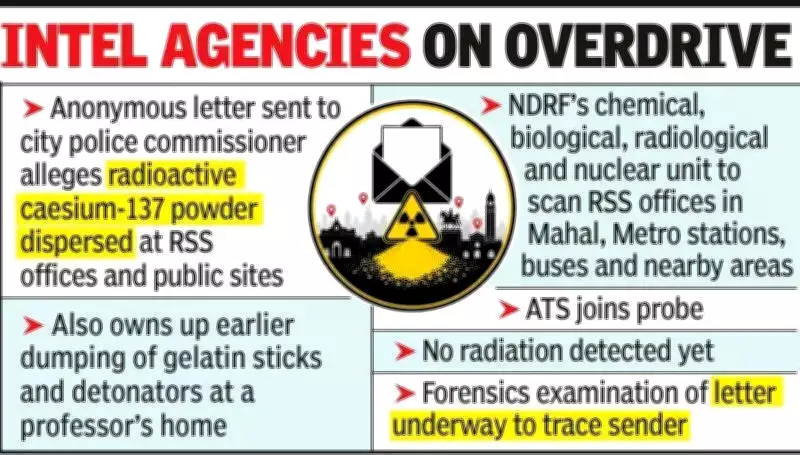
Nagpur was placed on high alert following the emergence of an anonymous letter that claimed the dispersal of radioactive caesium-137 powder in Rashtriya Swayamsevak Sangh (RSS) offices and other key public locations. The sender also took responsibility for dumping gelatin sticks and detonators at a professor's residence in central Nagpur earlier this month.
Response from Authorities
The National Disaster Response Force (NDRF) has deployed its specialized Chemical, Biological, Radiological, and Nuclear (CBRN) unit to conduct extensive scans of RSS offices in Mahal, Mahametro stations, bus stands, and surrounding areas. Teams are utilizing portable radiation detectors and collecting swipe samples from chairs, seats, and high-contact surfaces. State and central intelligence agencies, along with the State Anti-Terrorism Squad (ATS), have joined the investigation. Anti-sabotage checks are being carried out at sensitive locations.
Details of the Letter
Senior police officials confirmed that the letter, posted through the General Post Office (GPO) and addressed directly to the police commissioner, contains chilling details of radioactive contamination. A case has been registered under sections of the Bharatiya Nyaya Samhita and the Unlawful Activities (Prevention) Act (UAPA). Forensic examination of the letter is underway to trace the sender through handwriting, paper, and postal analysis. Senior officials appealed to the public to remain calm, avoid spreading rumors, and report any suspicious activity immediately. "No radiation has been detected so far," they assured, while confirming that the probe is progressing on multiple fronts, including possible links to earlier incidents.

Claims in the Anonymous Letter
A senior official told the Times of India that the anonymous sender, claiming to represent an exploited and backward class, alleged that caesium-137 powder had been sprinkled on chairs at RSS headquarters and offices in Mahal, the Hedgewar memorial at Reshimbagh, Metro trains on the Orange and Aqua lines near RSS and BJP offices, and city buses. The letter further advised citizens to demand Prussian blue pills as an antidote and taunted authorities to contact the Tarapur nuclear plant for radiation checks.
Health Risks of Caesium-137
Caesium-137 is a highly radioactive isotope produced as a fission product in nuclear reactors. It emits beta and gamma radiation and has a half-life of approximately 30 years. If dispersed as a fine powder, it can easily contaminate surfaces, be inhaled or ingested, and mimic potassium in the human body, spreading rapidly to muscles and organs. Even small quantities in a densely populated and historically significant area like Mahal—the bustling heart of Nagpur housing RSS offices—could pose significant public health hazards.
Authorities continue to monitor the situation and urge citizens to stay vigilant. The investigation remains active, with multiple agencies working to identify the sender and assess any potential risks.






