Activists have reported that a severe crackdown on nationwide protests in Iran has resulted in the deaths of at least 538 people, with fears that the actual number could be significantly higher. The announcement came on Sunday as Iranian authorities issued a stark warning, stating that US military assets and Israel would be considered "legitimate targets" if Washington uses force to protect demonstrators.
Mass Detentions and Information Blackout
According to the US-based Human Rights Activists News Agency (HRANA), more than 10,600 individuals have been detained over the past two weeks. The agency relies on a network of activists inside Iran to cross-check information and has provided accurate figures during previous periods of unrest. Iranian authorities have not released any official nationwide casualty figures.
The Associated Press noted it was unable to independently verify the death toll due to an ongoing internet blackout and restrictions on international phone calls. This near-total shutdown of internet services and cutting of phone lines has made assessing the scale of the protests from outside Iran increasingly difficult. Rights groups fear this information vacuum is empowering hard-liners within Iran's security apparatus to intensify the violent suppression.

Protests Persist Amidst Stark Warnings
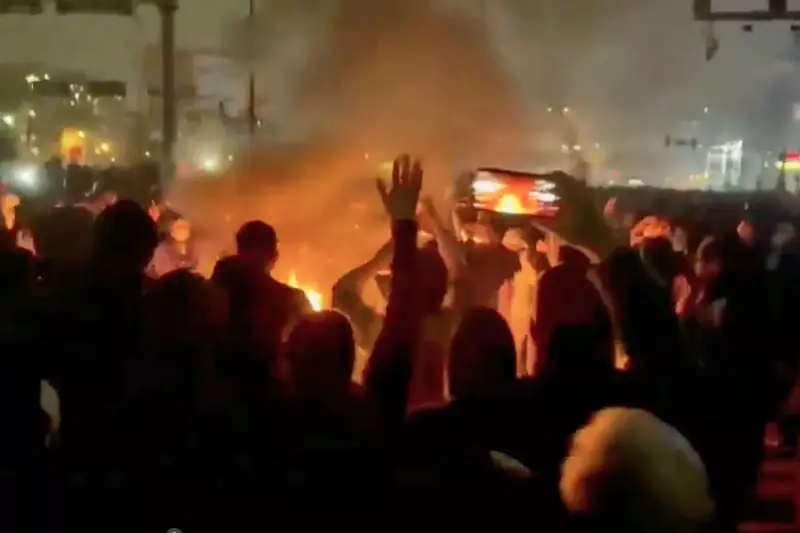
Despite the severe restrictions, activists and online footage indicate that protesters once again flooded the streets of Tehran and Iran's second-largest city, Mashhad, on Sunday. In response, US President Donald Trump voiced strong support for the demonstrators on social media, writing, "Iran is looking at FREEDOM, perhaps like never before. The USA stands ready to help!!!"
Two sources familiar with internal White House discussions revealed that Trump and his national security team have been weighing a range of potential responses against Iran, including cyberattacks and direct strikes by either the US or Israel. The White House has not indicated that any final decisions have been made.
The Iranian warning to the US and Israel was delivered during a parliamentary speech by hard-line speaker Mohammad Baagher Qalibaf. He declared, "In the event of an attack on Iran, both the occupied territory and all American military centers, bases and ships in the region will be our legitimate targets." He added that Iran would not limit itself to reacting after an attack but would act based on "any objective signs of a threat." Following the speech, lawmakers rushed the dais, chanting "Death to America!"
Regional Tensions and International Reactions
The US military stated it is "postured with forces that span the full range of combat capability" in the Middle East. Iran has previously targeted US forces at Al Udeid Air Base in Qatar, and the US Navy's Fifth Fleet is based in nearby Bahrain.
An Israeli official, speaking anonymously, said Israel was "watching closely." Israeli Prime Minister Benjamin Netanyahu, who discussed Iran with US Secretary of State Marco Rubio, praised the protesters, saying, "The people of Israel, the entire world, are in awe of the tremendous heroism of the citizens of Iran."
At the Vatican, Pope Leo XIV referred to Iran as a place "where ongoing tensions continue to claim many lives," expressing hope for dialogue and peace.
Nature of the Protests and Government Response
Videos circulating online, some believed transmitted via Starlink satellite systems, showed demonstrators gathering in neighborhoods like Punak in northern Tehran. Protesters were seen waving lit mobile phones, banging metal objects, and setting off fireworks, while security forces blocked streets. HRANA described the protest pattern in the capital as "scattered, short-lived, and fluid gatherings," a tactic developed in response to the heavy security presence.
In contrast, Iranian state television aired footage of calm streets in several cities, though notably omitted Tehran and Mashhad. The government's rhetoric has hardened significantly. Top security official Ali Larijani accused some demonstrators of actions "very similar to what ISIS does." State TV extensively covered the funerals of slain security force members, reporting deaths including six personnel in Kermanshah, 13 people in Fars province, and seven security forces in North Khorasan.

Even reformist President Masoud Pezeshkian, who initially sought to calm tensions, adopted a firmer tone in a Sunday broadcast. While acknowledging people's concerns, he stated, "the higher duty is not to allow a group of rioters to come and destroy the entire society."
Root Causes: Economic Collapse and Political Frustration
The unrest, which began on December 28, was triggered by the collapse of Iran's currency, the rial, which traded at over 1.4 million to the US dollar. This economic crisis is linked in part to sanctions over Iran's nuclear programme. What started as demonstrations over the soaring cost of living has since evolved into direct calls challenging Iran's theocratic system.
Exiled crown prince Reza Pahlavi has urged continued protests, though it is unclear if chants praising the former monarchy reflect genuine support for him or broader frustration with the post-1979 political order. The situation remains volatile, with the world watching as Iran grapples with one of its most significant domestic challenges in years.