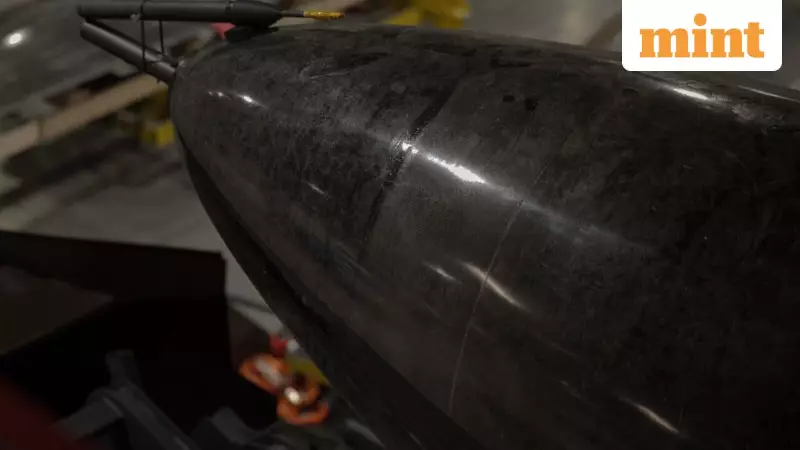
In a secretive facility in central Ukraine, engineers are working on a weapon they hope will change the dynamics of the war with Russia. Codenamed the "Flamingo," this massive, domestically-produced cruise missile represents Ukraine's ambitious push to build the capability to strike targets deep inside Russian territory, reducing its dependence on Western arms supplies.
The Flamingo: Ukraine's Answer to a Strategic Need
The Flamingo, officially known as the FP-5 missile, is a formidable piece of engineering. Longer than a city bus and weighing nearly 7 tons, it is designed to carry a powerful 2,500-pound warhead over a distance of more than 1,800 miles. This range would far exceed that of current Western systems like the U.S. Army Tactical Missile Systems (ATACMS) or the UK's Storm Shadow missiles supplied to Ukraine. It would even be comparable to Russia's own Kalibr and Kh-101 cruise missiles that have pounded Ukrainian cities.
The drive to develop such a weapon stems from a tactical gap. While Ukraine's domestically-made FP-1 drones have successfully carried out over 100 strikes on Russian oil refineries since August, causing billions in damage, their 230-pound warheads often allow Russia to repair facilities within a week. The Flamingo's much larger payload is intended to inflict lasting, catastrophic damage.

Ingenuity on a Shoestring Budget
The development story of the Flamingo is one of remarkable ingenuity and severe budget constraints. The missile is a product of Fire Point, a defence company founded in November 2022 by entrepreneur Denys Shtilerman. Frustrated by the high cost of drones he was procuring for the military via a charity, Shtilerman, a graduate of Moscow's top physics institute and a former Russian Defence Ministry employee, started the firm. It has since grown from 18 employees to over 2,000 people across 40 facilities, with a valuation exceeding $1 billion.
To keep costs down, Fire Point has adopted a philosophy of frugal innovation. The missile lacks sophisticated stealth features. Its jet engines are sourced from old Soviet-era aircraft, retrieved from storage across Ukraine. Iryna Terekh, the company's 33-year-old technical director, compares their reliability to a Kalashnikov rifle. For the flight controller, engineers tested models costing up to $500,000 but ultimately settled on an open-source version available freely online.
"Our strategy is to economize on the less important stuff but never save money on the stuff that really matters," said Terekh, a former furniture manufacturer for Ukraine's middle class.
Challenges and the Road Ahead
Despite its promise, the Flamingo faces significant hurdles. Defence experts note that the missile, with fewer than 100 test launches so far, has yet to prove it can consistently achieve its designed range. Its large size and weight make it slower and potentially easier for Russian air defences to spot and intercept.
The company's rapid expansion has also made it a target. Russia has struck its facilities twice. In response, Fire Point has built redundancy into its production chain, with each factory having at least one identical copy with the same equipment on standby. The company aims to scale production to seven Flamingo missiles per day, with each missile delivered to the Ukrainian armed forces and fired within two days of completion.
The missile's first declared combat use was in August 2025 against a Russian naval base in Crimea. Analysts like Fabian Hoffmann from the University of Oslo, citing satellite imagery, reported that only one of three launched missiles struck the target directly—a claim Fire Point disputes.
Nevertheless, Hoffmann emphasises the strategic significance: "They cannot guarantee those hits, but what they can guarantee is that there is a threat to those targets, and that threat alone does something to your adversary." A reliable long-range missile strips away Russia's traditional advantage of vast territorial depth, turning its homeland into a potential battlefield.

Fire Point's journey continues with Western backing, including funding from the UK and Germany and plans for a propellant factory in Denmark. Former U.S. Secretary of State Mike Pompeo joined its advisory board in November 2025. The company, while under investigation by Ukraine's National Anti-Corruption Bureau as part of a broader probe (it denies any wrongdoing), remains focused on a singular goal: true self-sufficiency where every component is made in Ukraine.
As Iryna Terekh poignantly summarises the challenge: "It's like repairing a car that is traveling at 130 miles per hour, while being shot at. Ukrainians are developing the ability to do that." The Flamingo is a bold, if imperfect, symbol of that relentless drive.