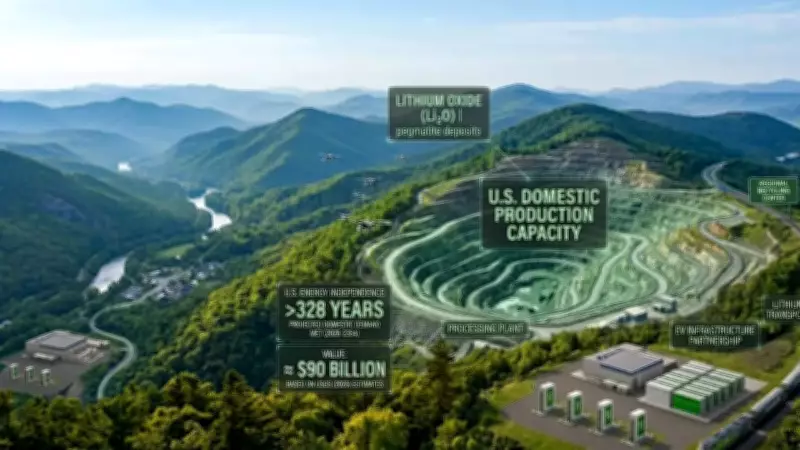
The United States Geological Survey (USGS) has identified undiscovered, economically recoverable lithium reserves in the Appalachian Mountains, totaling 2.3 million metric tons of lithium oxide. This discovery holds an estimated value of approximately 90 billion dollars and marks a vital shift for energy security in the United States.
Location and Significance
These reserves are primarily located in the 'Tin-Spodumene Belt' of the Carolinas, extending towards the northeast. The amount of lithium is sufficient to meet the nation's growing needs for centuries. With global demand for battery minerals soaring, this discovery provides an opportunity to cut back on imports from countries like China and Chile. It not only boosts the American electric vehicle market but also strengthens the country's resolve towards a future less dependent on foreign minerals.
USGS Identification and Critical Minerals List
The USGS has pointed out that the Appalachian region holds a large amount of spodumene, a lithium-containing mineral found in certain rock types. In the 2024 update, the US critical minerals list names lithium as crucial for both national security and economic growth. According to the journal published by the US Geological Survey, the United States imports more than 25 percent of its lithium needs. Therefore, this discovery of 2.3 million tons could become a key strategic resource for the country.

Historical Legacy of the Tin-Spodumene Belt
Lithium can be found in the Tin-Spodumene Belt, which extends from South Carolina into North Carolina. The Department of Energy's historical records show that during the mid-20th century, this region was the world's top lithium source. Recent studies by the National Renewable Energy Laboratory emphasize the importance of reopening these mines to help achieve the Biden-Harris administration's target of 50 percent electric vehicle sales by 2030.
Environmental Shift in Lithium Extraction
The International Energy Agency (IEA) predicts a 40-fold increase in global lithium demand by 2040. A study published in the National Institutes of Health discusses how extracting lithium from hard-rock pegmatites in areas like the Appalachians affects the environment differently than using brine evaporation ponds. By tapping into these local resources, approximately 130 million electric vehicle batteries could be powered, which would greatly reduce the carbon emissions tied to shipping minerals from overseas.
US Policy Incentivizing Local Mineral Extraction
The Federal Consortium for Advanced Batteries (FCAB) emphasizes the importance of establishing a complete domestic supply chain, from mining operations in the Appalachians to recycling processes. This focus is crucial for the government sector. Moreover, this initiative aligns with the Inflation Reduction Act's stipulations on sourcing minerals domestically to be eligible for clean vehicle tax credits. The Internal Revenue Service and the Department of the Treasury have outlined these requirements clearly.