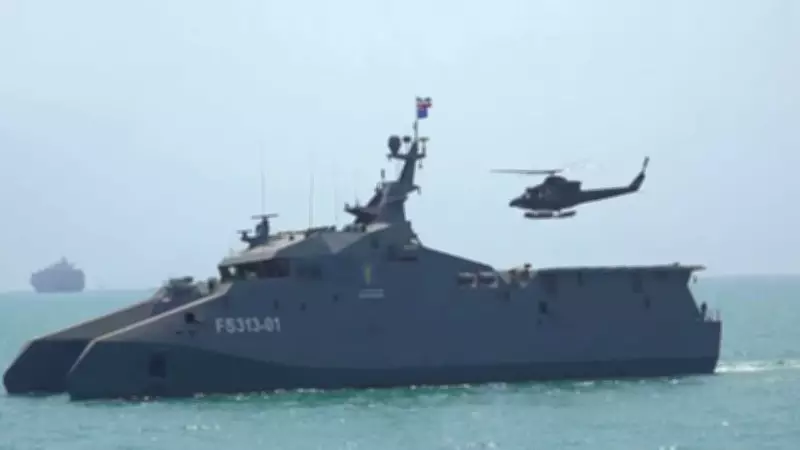
US Military Destroys Iran's Soleimani-Class Catamaran Warships in Major Escalation
The United States announced on Thursday that it has destroyed all four of Iran's Soleimani-class catamaran warships, marking a significant setback for the Islamic Revolutionary Guard Corps Navy (IRGCN). This development comes as the ongoing war involving the US, Israel, and Iran continues without signs of abatement, highlighting the intensifying naval confrontations in the region.
Origins and Significance of the Soleimani-Class Vessels
The first vessel in this class, the Shahid Soleimani, was commissioned in 2022 and named after the late IRGC General Qassem Soleimani, who was killed in a US drone strike in Iraq in 2020. Iran has a history of naming weapons systems after Soleimani, and this warship was formally unveiled in Bandar Abbas, a key southern port city. Constructed at the Shahid Mahallati Shipyard in Bushehr, satellite imagery revealed its early construction in March 2022, though official details were sparse at the time.
These warships were the largest and most advanced combatants in the IRGCN fleet, designed specifically for littoral combat and asymmetric operations. They combined missile systems, helicopters, unmanned aerial vehicles, and fast-attack boats, making them central to Iran's strategy for exerting naval influence in the Persian Gulf and surrounding waters.

Design and Advanced Features of the Catamaran Warships
The Soleimani-class ships feature a catamaran-style design with two parallel hulls, providing enhanced stability, speed, and maneuverability in coastal environments. Iranian media described the Shahid Soleimani as incorporating radar-evading or stealth-like features aimed at reducing its radar signature, though independent verification of these claims remains limited.
Equipped with four domestically developed engines, these vessels allowed for quick deployment and extended endurance at sea. Their larger hulls, compared to predecessors like the Shahid Nazeri, enabled them to carry helicopters and fast-attack boats from a stern ramp, functioning as command-and-control platforms for coordinating smaller IRGCN vessels and unmanned systems.
Armament and Combat Systems: A Formidable Arsenal
According to Iranian media reports, the Shahid Soleimani was the first IRGCN ship to feature a vertical launch system (VLS). Aerial photos during its unveiling showed six VLS cells, with additional covered areas possibly containing more missiles. Iranian sources claim the VLS can fire surface-to-air missiles (SAMs) with a range of about 93 miles, potentially aligning with upgraded Sayyad SAM variants.
Other reported weaponry includes:
- Four Ghadir anti-ship cruise missiles and two smaller Nasr-type anti-ship missiles.
- A single 30 mm autocannon with electro-optical targeting.
- Four 20 mm rotary cannons, possibly remotely operated.
- Capacity to launch helicopters and vertical take-off drones from a large flight deck.
- Electronic warfare, reconnaissance, and communications systems for enhanced situational awareness and self-protection.
Major General Mohammad Bagheri, then Chief of Staff of the Armed Forces, emphasized that this was Iran's first domestically developed warship with vertical launch and air defense systems, powered by indigenous software for target detection and weapon assignment.
Operational Role and Strategic Importance
These corvettes were primarily designed for coastal combat and asymmetric warfare, protecting and coordinating smaller IRGCN speedboats in the Persian Gulf. Their combination of missile systems, helicopters, and drone capability allowed them to act as floating command hubs, extending Iran's reach and providing enhanced firepower compared to the IRGCN's smaller vessels.
With a littoral strike function, they could operate in shallow waters and near ports while projecting anti-ship and air defense capabilities. The ability to carry fast-attack boats and drones increased their versatility in coordinating swarm tactics—a hallmark of IRGCN strategies in past encounters with US naval forces.

Destruction by US Strikes: A Decisive Blow
Despite their advanced capabilities, all four Soleimani-class corvettes have been destroyed by US military actions. Footage reviewed by sources shows the Shahid Sayyad Shirazi, another ship in the class, on fire after being struck by a US Navy torpedo—reportedly the first torpedo kill by the US since World War II. Smoke and missile launch trails are visible, though it is unclear if the vessel attempted to retaliate.
Earlier US strikes on Bandar Abbas, Iran's main naval base on the Strait of Hormuz, appear to have also destroyed other Soleimani-class corvettes, along with two frigates and a Kilo-class submarine, further degrading Iran's naval capabilities.
Significance of the Loss for Iran's Naval Power
The destruction of the Soleimani-class warships represents a major setback for the IRGCN. These vessels were among the most sophisticated in the fleet, combining surface-to-air and anti-ship missile systems, helicopters, drones, and command-and-control capabilities. Their loss reduces Iran's ability to operate in the Persian Gulf with coordinated naval assets, while also weakening its asymmetric maritime strategy.
While their operational effectiveness in combat has been debated, the Soleimani-class ships were symbols of Iran's efforts to enhance its naval power and challenge US and allied forces in the Gulf. Their destruction reflects the rapid escalation of conflict and the vulnerability of even the most advanced IRGCN assets in the face of US strikes, underscoring the ongoing tensions in the region.