Pune's Air Quality Crisis: Construction Dust and Illegal RMC Plants Create Toxic Environment
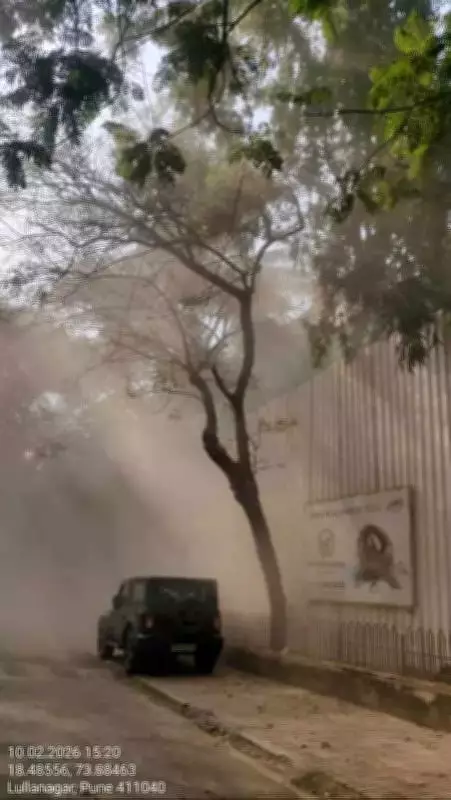
In Pune, the simple act of breathing has transformed into a daily struggle for residents across the city. Whether during morning jogs, commutes to work, evening strolls, or even while resting at home, toxic air has become an inescapable companion. What was once an invisible threat is now a visible, oppressive presence dominating urban life.
Citizens are resorting to medical interventions and minimizing outdoor exposure in desperate attempts to avoid being choked by the very air they must inhale. While increasing traffic and persistent garbage burning contribute to the problem, construction dust has emerged as a particularly insidious silent killer.
Construction Chaos: Dust Blankets Residential Areas
The air quality in rapidly developing neighborhoods like Bavdhan, Wakad, Hinjewadi, and Tathawade is deteriorating at an alarming rate. Residents express mounting frustration not only with unchecked construction projects but also with the proliferation of ready-mix concrete plants in their vicinity.

"You cannot open your windows for even sixty seconds without inviting a cloud of dust indoors," stated Ramesh Rokade, chairman of the Balewadi Welfare Federation. "Persistent illness has become commonplace—it's all dust-related allergies. With three or four active construction sites surrounding our housing society, how frequently can we forbid children from playing outside? We endanger our health daily because authorities refuse to enforce regulations and builders consistently ignore compliance."
According to Ravindra Sinha, convenor of the Baner Pashan Link Road Area Sabha, over one hundred major construction sites operate in Baner, Pashan, and Balewadi alone. "Not a single site adheres to the Central Pollution Control Board's 2017 guidelines or the Air Act of 1981," Sinha revealed. "The resulting pollution is compounded by construction vehicles that transform roads into dust bowls. Superficial sweeping proves ineffective, yet neither the Pune Municipal Corporation, Maharashtra Pollution Control Board, nor builders are implementing genuine solutions."
RMC Plants: Unchecked Contributors to Pollution
Ready-mix concrete plants supplying materials to construction sites have become significant, unregulated sources of air pollution. Purushottam Patil, a Tathawade resident, described his neighborhood as surrounded by RMC plants, with those in Marunji ignored by local gram panchayats and others overlooked by the Pimpri Chinchwad Municipal Corporation.
"We have filed numerous complaints without result," Patil said. "We even submitted documented evidence with photos and location tags to the MPCB. Approximately forty societies along this stretch suffer year-round breathing difficulties. RMC trucks speed through internal roads, making driving or walking hazardous. During evenings, four to five RMC trucks pass every minute alongside other construction vehicles."
Advocate Krunnal Ghare, a Bavdhan resident, discovered through an RTI application that while the MPCB officially recognizes 137 RMC plants in Pune, this number represents only a fraction of actual operations. "In Bavdhan alone, the RTI response acknowledges one legal plant—which has received a closure notice—while six or seven others operate illegally with impunity," Ghare explained. "This systemic failure has left thousands gasping for breath under a thick blanket of industrial dust, violating our fundamental right to a healthy environment."
Authorities Overwhelmed, Complaints Ignored
Recent pleas from resident groups have gone unanswered. The Baner Pashan Link Road Welfare Trust urgently demanded action from PMC Commissioner Naval Kishore Ram against construction-related dust pollution, noting widespread non-compliance with Bombay High Court directives and pollution board guidelines.
Their letter detailed specific violations:

- Absence of proper green or cloth netting around construction sites
- Irregular water sprinkling for dust suppression
- Uncovered construction vehicles with dusty tires
- Concrete and debris spillage onto roads instead of proper containment
Similarly, the Balewadi Welfare Federation requested installation of real-time AQI monitoring in Balewadi, strict dust control at Metro project sites, road dust suppression, green buffers with native species, and action against open garbage burning.
MPCB Regional Officer Babasaheb Kukade acknowledged the challenge: "We receive numerous complaints about RMC plant dust. While we issue closure notices for non-compliance with 2025 directives, enforcement is difficult. Many plants operate on diesel generators, making power cuts ineffective. Additionally, we have only twelve field staff for the entire Pune district to manage all pollution aspects."
Citizen Science Reveals Alarming Data
Through Parisar's AQI Walk initiative—a citizen-science activity where participants measure air quality with portable monitors—readings from December 2025 and January 2026 showed PM2.5 and PM10 levels consistently in poor to very poor categories, frequently exceeding 250 and sometimes reaching 400 or higher.
Measurements spiked near construction sites, traffic signals, and areas with limited air movement. Near waste burning locations, readings skyrocketed to 2,000, though levels decreased somewhat in internal residential areas away from main roads.
Legal Recourse and Expert Recommendations
Environment lawyer Maitreya Ghorpade advised residents to file detailed complaints with MPCB regional offices, highlighting breaches of consent conditions and Environmental Clearance stipulations regarding dust suppression, noise pollution, and debris handling. Simultaneous complaints can be lodged with municipal construction departments under the Maharashtra Regional and Town Planning Act.
"However, the most effective long-term solution often involves approaching the National Green Tribunal after documenting complaints with statutory authorities," Ghorpade noted. "The NGT has issued multiple orders admonishing negligent builders and, in appropriate cases, halting construction until adequate pollution controls are implemented."
As Pune's development accelerates, residents continue to demand responsible growth that prioritizes health through strict enforcement, systematic dust removal, and permanent action against pollution sources that have made clean air a distant memory in India's cultural capital.