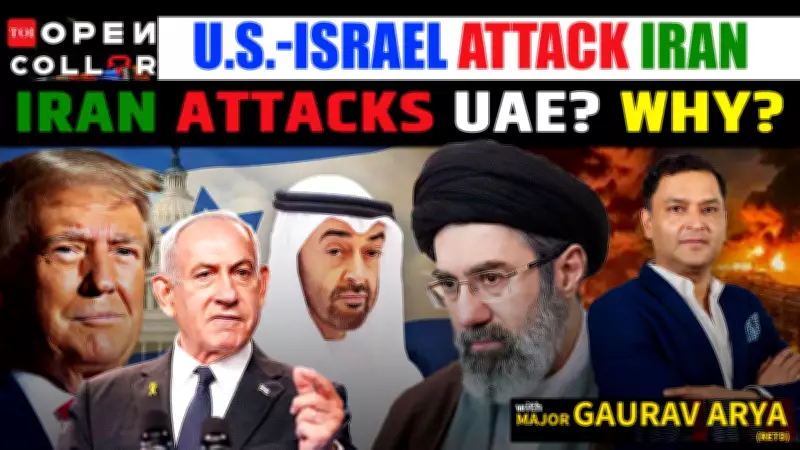
Iran Launches Retaliatory Strikes on UAE Following US-Israel Attacks
In a significant escalation of Middle East tensions, Iran has launched missile and drone strikes against United Arab Emirates energy infrastructure following coordinated attacks by United States and Israeli forces. This development comes after the targeting of the world's largest natural gas field, which is jointly operated by Iran and Qatar in the Persian Gulf region.
Strategic Shift: Economic Warfare Over Direct Military Confrontation
Analysts note that Iran's decision to focus retaliation on Gulf energy infrastructure rather than direct strikes against Israel represents a calculated strategic shift. Major Gaurav Arya, in his analysis, emphasizes that Tehran appears to be pursuing economic warfare as its primary response mechanism. This approach targets the financial stability and investment climate of Gulf Cooperation Council nations, particularly the UAE.
The scale of Iran's attacks on Gulf energy facilities has been substantial, involving coordinated missile and drone strikes designed to maximize disruption to critical infrastructure. These strikes have specifically targeted oil production facilities, export terminals, and energy transportation networks that are vital to regional economies.

UAE as Primary Target: Dubai's Global Financial Hub Status
Iran's focus on the United Arab Emirates, particularly Dubai, reveals a strategic calculation about global economic vulnerabilities. The UAE has positioned itself as a major international financial center and investment destination, with Dubai serving as a critical hub for foreign direct investment throughout the Middle East and North Africa region.
This economic warfare strategy directly impacts what analysts describe as a "$5.2 trillion game" involving interconnected investments between the UAE, Qatar, and United States financial institutions. By destabilizing the UAE's economic environment, Iran aims to create ripple effects throughout global financial markets and undermine confidence in Gulf investment security.
Broader Implications for Middle East Stability
The current crisis represents one of the most significant escalations in regional tensions in recent years. Iran's decision to target Gulf energy infrastructure rather than engage in direct military confrontation with Israel suggests Tehran is calculating broader economic consequences over immediate military objectives.
This development raises critical questions about the future stability of energy markets, global investment patterns in the Middle East, and the potential for further escalation involving multiple regional actors. The situation continues to evolve rapidly, with international observers closely monitoring how Gulf nations and their global partners will respond to these unprecedented economic warfare tactics.