Hyderabad's Lake Restoration Efforts Confront Groundwater Recharge Challenges
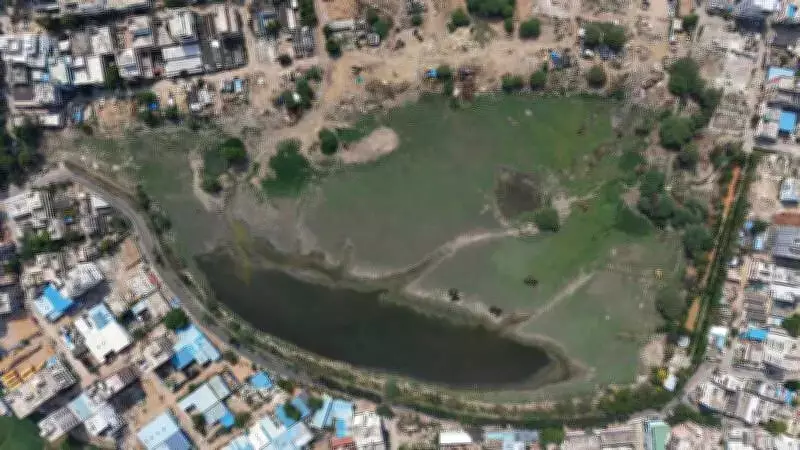
As Hyderabad grapples with an early onset of water scarcity this March, the city's focus has intensified on lake rejuvenation as a strategic response to plummeting groundwater levels. The Hyderabad Disaster Response and Asset Protection Agency (HYDRAA) has recently completed restoration work on three significant water bodies: Bum-Rukn-ud-Dowla Lake, Bathukamma Kunta, and Kukatpally Nalla Cheruvu. Despite these ambitious efforts, the anticipated impact on groundwater recharge has been minimal so far, with water levels in adjacent areas persistently ranging from eight to ten metres below ground level.
Expanded Lake Areas Yet Limited Hydrological Benefits
Officials from HYDRAA emphasize that the advantages of lake restoration are not immediate and require sustained commitment over time. Decades of environmental neglect, substantial debris accumulation, and widespread encroachments have created complex challenges that demand long-term remediation strategies. The recent rehabilitation projects have substantially increased the physical dimensions of these lakes. Kukatpally Nalla Cheruvu, which had diminished to approximately 14 acres, has been revitalized to cover nearly 30 acres. Similarly, Bum-Rukn-ud-Dowla Lake has been expanded from four acres to around 18 acres, while Bathukamma Kunta, which had nearly disappeared, has been restored to encompass about five acres.
Environmental Experts Highlight Critical Infrastructure Gaps
Environmental advocates recognize these restoration initiatives as positive steps forward but stress that ecological functionality must be fully restored to achieve meaningful groundwater replenishment. A primary concern raised by experts is the ongoing inflow of untreated sewage into these lakes even after restoration work has been completed. Environmentalist B V Subba Rao, with over thirty years of experience in lake restoration projects across India, stated that preventing sewage contamination is absolutely essential for success. He observed that despite substantial financial investments in lake rejuvenation over the years, outcomes have frequently been disappointing due to neglect of fundamental ecological principles.

The foundation of effective lake restoration involves identifying and securing water inlets, preventing further contamination, and ensuring adequate sewage treatment infrastructure, Subba Rao emphasized. Currently, both Kukatpally Nalla Cheruvu and Bum-Rukn-ud-Dowla Lake lack dedicated sewage treatment plants, representing a significant deficiency in their rehabilitation. For Bathukamma Kunta, authorities intend to redirect wastewater to a treatment facility under construction in Amberpet. Preliminary assessments indicate that Bum-Rukn-ud-Dowla Lake would require an STP with capacity between 10 and 15 million litres per day, while Kukatpally Nalla Cheruvu would need a facility exceeding 10 MLD capacity.
Long-Term Maintenance and Holistic Approaches Required
Madhulika Chaudhary, renowned for her work reviving lakes including Pedda Cheruvu and Neknampur Lake in Hyderabad, pointed out that establishing sewage treatment plants represents only part of the solution. Creating an STP is one challenge, but maintaining it effectively over the long term presents another substantial obstacle, she noted. Chaudhary cited the example of Durgam Cheruvu, where despite the installation of two STPs with capacities of 7.5 MLD and 5 MLD, approximately 20 MLD of untreated sewage continues to enter the lake daily. The recent proliferation of water hyacinth, which thrives in polluted conditions, demonstrates that infrastructure alone cannot solve contamination problems without effective inflow control mechanisms.

Beyond conventional engineering solutions, environmental specialists advocate for more comprehensive, nature-based approaches to lake restoration. Environmental scientist K Babu Rao, with four decades of experience in water and air pollution projects in Hyderabad, highlighted the importance of integrating natural treatment systems with traditional methods. Floating treatment wetlands can substantially enhance water quality, while aerators assist in breaking down organic waste, he explained. Proper stormwater treatment systems, diffusers, and fully operational STPs at all outflow points are also essential components of a successful restoration strategy.
Official Perspective and Future Plans
A V Ranganath, Commissioner of HYDRAA, acknowledged that aquifer recharge is inherently gradual. It would require at least two monsoon cycles for the restored lakes to begin demonstrating measurable improvements in groundwater levels, he stated. The agency is currently investigating possibilities for establishing sewage treatment plants on government land reclaimed from encroachments along the Full Tank Level areas of these lakes. We are engaged in discussions to utilize one to two acres of adjacent government land for constructing STPs specifically for the revived lakes, Ranganath confirmed.
The comprehensive restoration of Hyderabad's lakes represents a critical component of the city's water security strategy, but achieving meaningful groundwater recharge will demand integrated solutions addressing both infrastructure development and ecological preservation. As climate patterns evolve and urban water demands increase, the success of these initiatives will significantly influence Hyderabad's resilience against future water scarcity challenges.