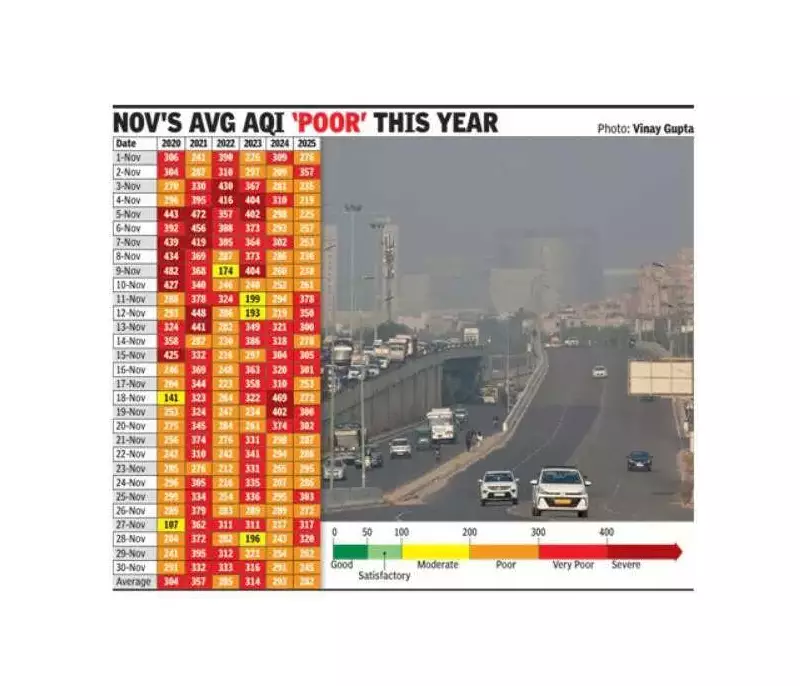
Gurgaon has witnessed its cleanest November air since 2020, according to official data, though concerns about monitoring reliability and station outages have cast shadows over the reported improvement.
Improvement Amid Uncertainty
The city's average Air Quality Index (AQI) for November stood at 282, categorized as 'poor' but showing improvement from last year's 293 reading. Historical data from the Central Pollution Control Board (CPCB) reveals this marks the best November performance in four years, with previous years recording significantly higher averages: 304 in 2020, 357 in 2021, 285 in 2022, and 314 in 2023.
However, this positive trend comes with significant caveats. Multiple monitoring stations experienced intermittent outages throughout the month, while several displayed unusually low pollution readings on days when the city was visibly covered in haze.

Monitoring Gaps Raise Concerns
Officials have acknowledged technical issues affecting more than one monitoring station during this period. The patchy monitoring has raised fundamental questions about whether the reported numbers accurately reflect the actual ambient pollution levels experienced by Gurgaon's residents.
Experts point to another concerning factor influencing readings. Over the years, the expansion of green cover around monitoring sites has created cleaner "pockets" that may not represent the pollution exposure faced by commuters on major roads and thoroughfares.
Expert Analysis and Recommendations
Shubhansh Tiwari, research associate at Centre for Science and Environment who tracks CPCB datasets, emphasized the data reliability issue. "When monitors go down during key pollution episodes, the annual average gets skewed", Tiwari explained. "The data gap is a concern because it affects how we interpret long-term trends."
Environmental specialists stress that Gurgaon requires continuous and reliable air-quality monitoring systems coupled with consistent, year-round efforts focused on reducing emissions at their source. Only through such comprehensive measures can the city achieve sustained, long-term improvement in air quality that truly benefits all residents.
The current situation highlights the critical need for robust monitoring infrastructure that can provide accurate data to guide effective pollution control policies and protect public health in one of India's most rapidly developing urban centers.