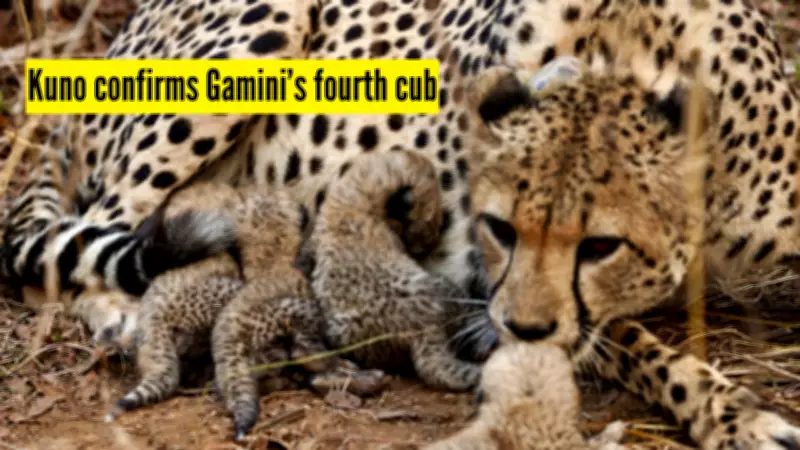
India's Cheetah Reintroduction Programme Achieves New Milestone with Fourth Cub Birth
India's ambitious effort to restore the cheetah to its native grasslands has reached another significant milestone. Union Environment Minister Bhupender Yadav announced on Friday the birth of a fourth cub to South African cheetah Gamini at Kuno National Park in Madhya Pradesh. This development pushes the country's total cheetah population to 39, a notable achievement in the ongoing reintroduction programme.
Intensive Monitoring Confirms Healthy Cubs
The presence of the fourth cub was confirmed through intensive monitoring by field and veterinary teams, who have been closely tracking the cheetahs' health and adaptation. Minister Yadav shared the update on X, stating, "Kuno National Park is pleased to announce the birth of a fourth cub to female cheetah Gamini. All four cubs are presently healthy and doing fine." This news comes just days after the announcement of three cubs born to Gamini on February 18, highlighting rapid progress in breeding success.
The minister emphasized that this reflects the continued commitment to scientific management and conservation under Project Cheetah. With the addition of the new cub, the total number of cheetahs in India now stands at 39, including 28 cubs born within the country. Wildlife officials have repeatedly stressed that cub survival is a critical indicator of the programme's long-term success, and the health of all four cubs suggests stable maternal care and effective habitat management at Kuno.

Project Cheetah: A Landmark Conservation Initiative
Project Cheetah was launched on September 17, 2022, as the world's first intercontinental translocation project for large wild carnivores. It aims to reintroduce cheetahs to India, where the species was declared extinct in 1952. The initiative began with the arrival of eight cheetahs from Namibia, followed by 12 from South Africa in February 2023, and recently, nine cheetahs from Botswana—six females and three males—were welcomed at Kuno National Park.
Kuno National Park was selected as the primary release site after extensive habitat preparation, including prey base augmentation and village relocations to create a conducive ecosystem. Since their arrival, the cheetahs have undergone phased releases from quarantine enclosures into larger acclimatisation zones and, in some cases, into the wild. Veterinary teams and forest officials maintain close tracking using radio collars and field patrols to manage health risks, territorial adjustments, and breeding outcomes.
Significance of India-Born Cubs for Sustainability
The birth of India-born cubs is regarded as one of the most important indicators for gauging the sustainability of Project Cheetah. The fact that 28 cubs have been born in India suggests that the cheetahs are adapting well to their new environment. As Kuno continues to see new additions in the form of India-born cubs, their survival into adulthood will be crucial for achieving a self-sustaining cheetah population.
Minister Yadav expressed optimism, stating, "With a thriving population of 39 cheetahs in India, including 28 India-born cubs, the ambitious Project Cheetah, undertaken under the environmentally-conscious leadership of PM Shri Narendra Modi ji, has been a great success." This milestone underscores India's dedication to wildlife conservation and ecological restoration, setting a precedent for global conservation efforts.