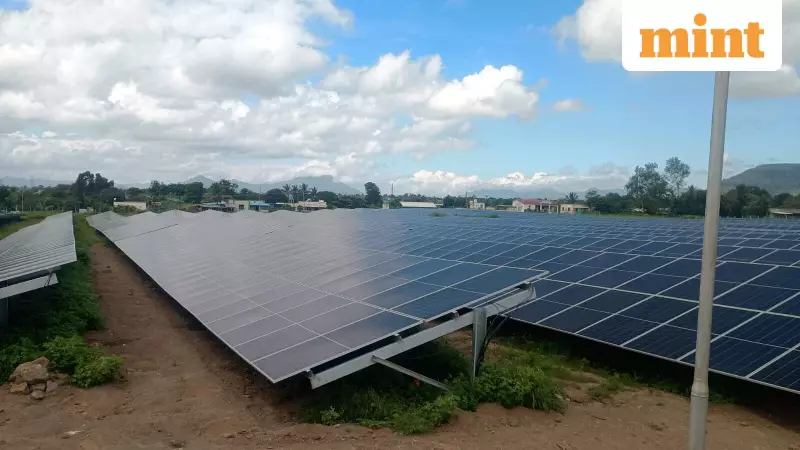
China's Clean Energy Revolution Reshapes Global Markets and Geopolitics
The scale of China's renewable energy transformation is truly staggering, with implications that will reverberate across global markets and international relations for decades to come. As the world's largest manufacturer, China has developed an unprecedented capacity for clean energy production that is fundamentally altering the global energy landscape.
Unprecedented Scale of Renewable Expansion
By the end of last year, China had installed a remarkable 887 gigawatts of solar-power capacity—nearly double the combined total of Europe and America. To put this in perspective, the country used 22 million tonnes of steel in 2024 alone to construct new wind turbines and solar panels, enough material to build a Golden Gate Bridge every single working day of that year.
China's wind and solar electricity generation reached 1,826 terawatt-hours in 2024, which represents five times more energy than contained in all 600 of its nuclear weapons. This extraordinary output positions China as a new type of superpower—one that deploys clean electricity on a planetary scale rather than relying solely on military might.

Transforming Global Energy Dynamics
The convergence of China's enormous manufacturing capacity and its insatiable demand for cheap, domestically produced electricity has created a virtuous cycle with global implications. China can now produce almost a terawatt of renewable-energy capacity annually, equivalent to the output of more than 300 large nuclear power plants.
This manufacturing prowess enables China to provide clean-energy capacity to the world at prices cheaper than any alternative, including traditional fossil fuels like coal and natural gas. The country's efficiency improvements continue to drive down costs, making renewable energy increasingly accessible worldwide.
Geopolitical Implications and Climate Leadership
China's renewable energy revolution is reshaping international climate negotiations and geopolitical relationships. The country has exceeded or is on track to exceed most pledges made under the UN Framework Convention on Climate Change since signing the Paris agreement a decade ago.
As world leaders gather for climate summits, they do so in a context fundamentally shaped by China's commitments to more than double its renewable-energy capacity and implement measured emissions reductions by 2035. These targets may well be surpassed given China's current trajectory.
Exporting the Clean Energy Revolution
China is now exporting its renewable energy expertise and technology globally, with particularly significant implications for developing countries where the battle against climate change will ultimately be won or lost. Remarkably, China currently makes more money from exporting green technology than America earns from exporting fossil fuels.
The appeal of Chinese renewable technology is evident across developing nations, from solar panels on Pakistani rooftops to wind farms in African nations. This export success stems from simple economics: renewables have become cheaper than conventional alternatives.
Economic and Environmental Alignment
China's clean energy expansion represents a rare alignment of economic and environmental interests. For the first time, the world's largest manufacturer finds its commercial incentives increasingly synchronized with global climate objectives. More clean technology deployment worldwide reduces China's own climate risks while simultaneously creating economic opportunities.
This convergence addresses what economists call the "free-rider problem" in climate action, where countries traditionally sought the benefits of slowing climate change while avoiding associated costs.
Challenges and Concerns
Despite these remarkable developments, significant challenges remain. China continues to rely heavily on coal power, and more comprehensive reforms to grid infrastructure and energy markets could accelerate the transition from renewables as an adjunct to renewables as the primary energy source.

Geopolitical concerns also persist regarding over-reliance on Chinese technology, particularly given the country's control over critical mineral supplies and its assertive foreign policy under President Xi Jinping's leadership. However, unlike fossil fuels that can be withheld, renewable technologies continue producing power regardless of political relationships once installed.
Global Implications and Future Prospects
The potential benefits of China's clean energy revolution are enormous. While limiting global temperature increases to 1.5°C may no longer be achievable, solar and wind power offer the best hope for containing further warming. Beyond climate considerations, cheap, abundant clean energy promises to improve billions of lives in developing countries through enhanced energy access and economic development.
The world stands at a critical juncture where embracing China's renewable energy capabilities could accelerate the global transition to sustainable energy systems. This technological revolution, driven by both self-interest and global necessity, represents one of the most significant geopolitical and economic developments of our time.