CAQM Proposes Stricter Industrial Emission Standards for Delhi-NCR
In a significant regulatory move, the Commission for Air Quality Management (CAQM) has proposed stricter particulate emission standards for industries across Delhi-NCR. However, this initiative may leave a major driver of the region's air pollution largely unaddressed – particles that form in the atmosphere through chemical reactions rather than being emitted directly from industrial stacks.
New Emission Limits and Implementation Timeline
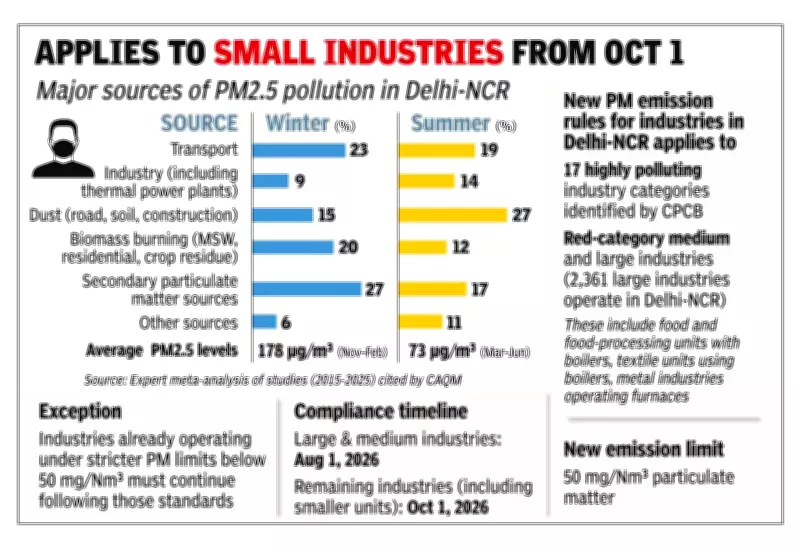
Through a statutory order issued on February 21, the commission has proposed a uniform particulate matter (PM) emission limit of 50 mg/Nm³ for multiple industrial categories across the National Capital Region. The revised limit will apply to large and medium industries starting August 1, with remaining industries required to comply by October 1.
The directive covers 17 highly polluting industrial sectors, red-category medium and large industries, food and textile units operating boilers or thermic fluid heaters, and metal industries running furnaces. CAQM stated that the new standard – recommended by the Central Pollution Control Board (CPCB) based on studies including those by IIT Kanpur – is technically achievable and intended to cut particulate emissions from industrial stacks.

The Challenge of Secondary Particulate Matter
Despite these measures, CAQM's own expert assessment indicates that a substantial share of particulate pollution in Delhi-NCR is not emitted directly from sources such as factories or vehicles. Much of it forms in the atmosphere through chemical reactions involving gases released by industries, power plants, vehicles, and other combustion sources.
This secondary particulate matter includes compounds such as ammonium sulphate, ammonium nitrate, and secondary organic aerosols. Secondary particles form when gases such as sulphur dioxide (SO₂), nitrogen oxides (NOx), ammonia (NH₃), and volatile organic compounds (VOCs) react in the air. Once formed, they add to PM2.5, which is the fine particulate matter that can penetrate deep into lungs and enter the bloodstream.
Significant Contribution to Regional Pollution
A meta-analysis of air pollution studies conducted between 2015 and 2025 estimates that secondary particulate matter contributes about 27% of PM2.5 pollution in winter and 17% in summer in Delhi-NCR, making it one of the largest contributors to fine particle pollution in the region.
The analysis reveals how source contributions vary by season. In winter, transport contributes about 23% of PM2.5, biomass burning around 20%, road and construction dust about 15%, and industrial sources, including thermal power plants, about 9%, while secondary particulates account for the largest share at around 27%.
In summer, dust becomes the dominant source at about 27%, followed by transport at 19%, secondary particulates at 17%, and industrial emissions at about 14%.
Expert Concerns About Regulatory Focus
Despite this significant contribution, the new CAQM directive focuses mainly on reducing direct particulate emissions from industrial stacks, without a parallel tightening of limits for gases that drive secondary particle formation. Experts argue that unless emissions of precursor gases such as SO₂ and NOx are reduced alongside particulate emissions, tighter PM standards alone may not deliver sustained improvements in air quality across Delhi-NCR.
"Reducing particulate emissions from industrial stacks is important, but it focuses only on the particles emitted directly from sources. Until and unless we target emission load reduction of precursor gases such as SO₂, NOx, and VOCs, we will not be efficient in our actions to control pollution," said Sunil Dahiya, founder and lead analyst at Envirocatalysts.
Dahiya emphasized that policies should move beyond intensity-based standards and focus on cutting the total volume of pollution released into the atmosphere.
District-Level Evidence from Haryana
District-level research from Haryana underscores the scale of secondary pollution across the region. A CREA analysis found that secondary pollutants contribute nearly one-third of PM2.5 across most districts in the state, including NCR cities such as Gurgaon and Faridabad.

The study identified ammonium sulphate as a dominant component, with concentrations ranging from 12 to 20 micrograms per cubic metre and accounting for 29-34% of PM2.5 mass across districts. Faridabad recorded the highest share, with ammonium sulphate contributing 34% of PM2.5 at an average concentration of 20 μg/m³.
Gurgaon, Sonipat, and Palwal each showed about 33% contribution, while Rohtak and Jhajjar were around 32%. Even districts with comparatively lower pollution levels demonstrated significant secondary contributions. Panchkula and Yamunanagar recorded ammonium sulphate concentrations of about 12 μg/m³, accounting for 30% of PM2.5, while Ambala reported 31% and Sirsa 29%.
Central and western Haryana districts, including Hisar, Fatehabad, Karnal, Kaithal, Jind, and Nuh, showed a similar pattern, with ammonium sulphate contributing 31-32% of PM2.5 mass.
Implications for Pollution Control Strategy
The findings suggest that fine particle pollution in Haryana and the wider NCR is driven not only by visible sources such as dust, traffic, and construction, but also by atmospheric chemistry involving precursor gases. This creates a complex pollution challenge that requires multi-pronged regulatory approaches.
CAQM has directed the governments of Haryana, Uttar Pradesh, and Rajasthan, along with the Delhi government and regional pollution control boards, to ensure compliance with the revised industrial emission norms and to run awareness campaigns ahead of the implementation deadlines.
However, the current regulatory focus on direct particulate emissions from industrial stacks may need to be complemented with stronger controls on precursor gases to effectively address the significant contribution of secondary particulate matter to Delhi-NCR's persistent air quality problems.