Maharashtra Women's Policies Show Progress but Face Implementation Hurdles, Seminar Reveals
Speakers at a seminar reviewing Maharashtra's four women's policies acknowledged that while these initiatives have significantly expanded women's participation in governance, their implementation remains uneven. Many sections of society, particularly working-class and minority women, have yet to benefit fully from the policies' intended advantages.
Seminar Details and Organisational Background
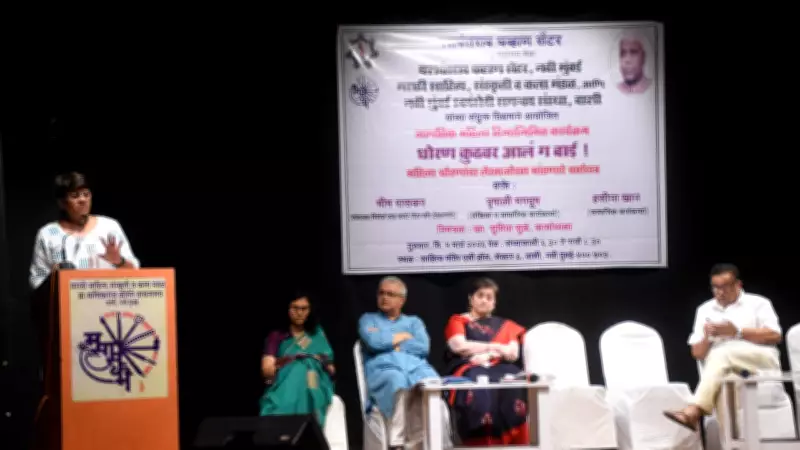
The discussion, titled "Dhoran Kuthevar Aala Ga Bai!" (Where has the policy reached?), was organised on Thursday at Sahitya Mandir Hall in Navi Mumbai. This event formed part of a statewide series of seminars commemorating International Women's Day. The initiative was spearheaded by the women's wing of the Yashwantrao Chavan Centre, aiming to critically assess the progress of the four women's policies adopted by Maharashtra over recent decades.
The seminar was jointly organised by the Navi Mumbai district centre of the Yashwantrao Chavan Centre, the Navi Mumbai Marathi Sahitya, Sanskruti and Kala Mandal, and the Navi Mumbai Voluntary Organisations Coordination Committee. Subhash Kulkarni, president of the Navi Mumbai Marathi Sahitya, Sanskruti and Kala Mandal, chaired the event. Pramod Karnad, president of the Yashwantrao Chavan Centre's Navi Mumbai centre, extended a welcome to attendees, while honorary programme manager Datta Balsaraf delivered the vote of thanks. Sadhana Tippanakaje, head of the women's wing, introduced and moderated the session, which attracted over 100 social activists from Navi Mumbai, along with office-bearers of the Chavan Centre and Yashaswini Navi Mumbai coordinator Manisha Desai.

Positive Changes and Persistent Challenges in Governance
Bhim Raskar, director of the Resource and Support Centre, highlighted that the policies have fostered notable advancements, such as empowering women representatives, ASHA workers, and anganwadi workers with increased responsibilities in local governance. "A few years ago, it was challenging to identify women candidates for elections, but today competition among women in politics has intensified," Raskar observed.
However, Raskar also pointed out critical shortcomings. He noted that many women representatives later reverse their positions on issues, and women continue to be inadequately included in the budgeting process. To address these gaps, he advocated for increasing the number of women spokespersons within political parties and urged parties to develop internal gender policies. Additionally, Raskar emphasised that the provisions of the POSH (Prevention of Sexual Harassment) law should extend to political parties. He also supported campaigns like the Jyotiba Putra Abhiyan to cultivate support systems among men, fostering a more inclusive environment.
Overlooked Communities and Systemic Issues
Senior social activist Hasina Khan raised concerns about the exclusion of Muslim women during policy implementation. "Although the policies are designed for all women, Muslim women are frequently overlooked. They continue to face neglect in mainstream education and employment opportunities as well," Khan stated, underscoring the need for more equitable application.
Vrushali Magdum, trustee of Stree Mukti Sanghatana, provided a comprehensive review of key aspects of the four policies, focusing on education, health, gender equality, and violence against women. She remarked that despite 32 years having passed since the introduction of the first women's policy in Maharashtra, its benefits have not reached large segments of working women.
Magdum further illustrated systemic failures by noting that although the law against domestic violence was enacted in 2005, cases of domestic abuse and dowry-related deaths persist even in 2026. "For effective implementation of these policies, concerted efforts are required not only from the government but also from social organisations and ordinary citizens," she asserted. Magdum added that complete implementation will remain elusive until broader societal transformation occurs, highlighting the interconnected nature of policy success and cultural change.

Call to Action and Future Directions
The seminar concluded with a unified call for enhanced collaboration among government bodies, political parties, and civil society to bridge implementation gaps. Participants stressed the importance of continuous monitoring and adaptive strategies to ensure that Maharashtra's women's policies deliver tangible benefits to all women, irrespective of their socio-economic or minority status. The event served as a pivotal platform for dialogue, aiming to catalyse further progress in gender equality across the state.