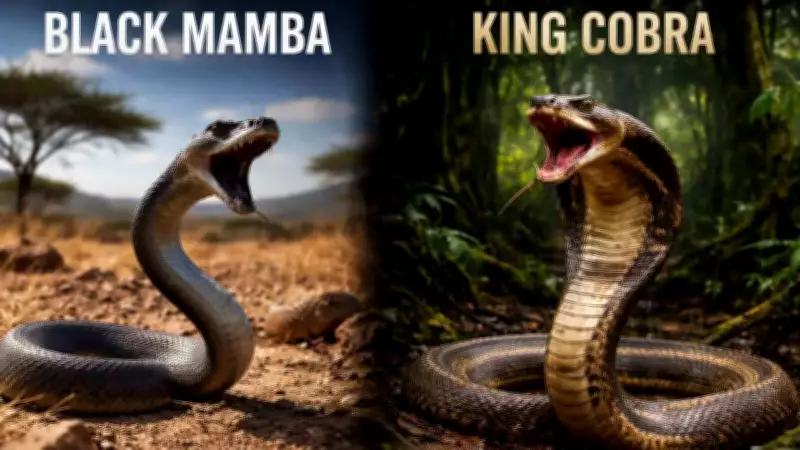
Black Mamba vs King Cobra: The Ultimate Snake Showdown
When discussing the world's most terrifying snakes, two names consistently dominate the conversation: the black mamba and the king cobra. These legendary reptiles have earned their fearsome reputations not merely through size, but through devastating efficiency in their hunting and defensive capabilities. While they inhabit different continents and employ distinct survival strategies, both represent the pinnacle of predatory evolution in the serpent world.
Geographical Realms: Africa vs Asia
The black mamba and king cobra are separated by vast oceans and continents, each ruling its own domain. The black mamba claims the sun-drenched savannas, rocky hills, and open woodlands of sub-Saharan Africa. These snakes prefer expansive habitats where they can utilize their incredible speed, often taking refuge in abandoned burrows or hollow trees.
In contrast, the king cobra reigns over the dense, humid forests of South and Southeast Asia, including regions of India, Indonesia, and Thailand. These massive serpents thrive in bamboo thickets and mangrove swamps, environments that provide perfect camouflage for ambushing prey.

Physical Characteristics: Speed Versus Size
The physical differences between these snakes are immediately apparent. The king cobra holds the title as the world's longest venomous snake, with specimens reaching an astonishing 18-20 feet in length. This considerable size gives the king cobra significant physical dominance in its environment.
While the black mamba measures a still-impressive 14 feet maximum, its design prioritizes agility over bulk. The mamba's slender, streamlined body enables remarkable speed and precision movements, making it one of the fastest land snakes on Earth.
Venom Comparison: Potency Versus Volume
The most crucial distinction between these deadly predators lies in their venom delivery systems. Black mambas possess exceptionally potent neurotoxic venom that can paralyze a victim's nervous system within minutes. Without immediate medical intervention, a black mamba bite often proves fatal due to this rapid-acting toxicity.
The king cobra employs a different strategy: while its venom is less potent per drop than the mamba's, it delivers massive quantities—hundreds of milligrams in a single bite. This overwhelming volume of venom can kill even large animals, including elephants under certain circumstances. Essentially, the black mamba relies on surgical precision, while the king cobra depends on overwhelming force.
Behavior and Hunting Techniques
Both snakes exhibit fascinating behavioral adaptations. The black mamba's incredible speed allows it to strike multiple times in rapid succession, making it an exceptionally efficient hunter of small mammals and birds. Despite their fearsome reputation, black mambas are generally shy and will retreat when possible, only becoming aggressively defensive when threatened.
The king cobra displays unique dietary preferences, specializing in hunting other snakes—including venomous species. While not as fast as the black mamba, the king cobra's size and strength allow it to overpower even large constrictors. Like its African counterpart, the king cobra typically avoids confrontation but becomes formidable when cornered.
Evolutionary Paths to Dominance
These two snakes represent divergent evolutionary solutions to the challenge of survival. The black mamba exemplifies the path of speed, precision, and highly efficient venom delivery. Its adaptations make it perfectly suited to the open landscapes of Africa where quick strikes and rapid retreats are advantageous.
The king cobra demonstrates how size, strength, and overwhelming venom volume can create an apex predator. Its adaptations serve it well in dense Asian forests where ambush hunting and physical dominance determine success.
Neither snake can be declared universally "more dangerous" than the other—each represents the peak of predatory adaptation within its specific ecological niche. Their existence proves that nature cultivates diversity in danger, creating multiple pathways to becoming an effective predator. Both the black mamba and king cobra stand as testaments to evolutionary innovation, reminding us that deadly efficiency comes in many forms across the animal kingdom.