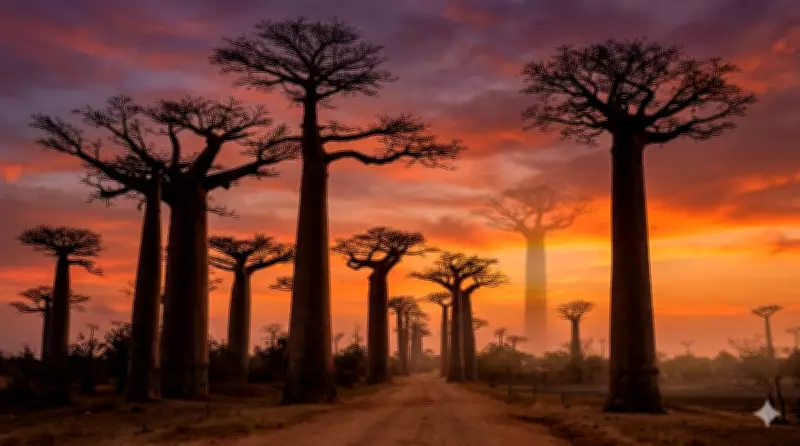
Madagascar's Baobabs: Ancient Guardians of Earth's Climate Secrets
The majestic baobabs of Madagascar are far more than iconic silhouettes against the sky; they serve as living archives of our planet's climatic history. These colossal trees, some over a millennium old, silently document environmental changes year after year, offering a unique window into the past.
Nature's Time Capsule: How Baobabs Record Rainfall
Often called nature's time capsules, baobab trees embed climate information within their annual growth rings as chemical signatures. A groundbreaking study titled 'Baobab isotope records and rainfall forcing in Southwest Madagascar over the last 700 years' reveals that researchers have successfully extracted rainfall records spanning seven centuries from these rings. By analyzing carbon isotopes in baobab rings dating back to the 1300s, scientists have created what they describe as "a natural rain gauge going back into the centuries."
The scientific principle behind this is precise: during drier periods, trees absorb higher levels of heavy carbon isotopes (¹³C) as part of water conservation efforts, while wetter years show reduced absorption. This method has allowed experts to reconstruct detailed rainfall patterns with remarkable accuracy.

700 Years of Climate Patterns Unveiled
The findings paint a vivid picture of Madagascar's environmental past. According to the research, the region experienced peak precipitation between 1350 and 1450, followed by a prolonged and severe dry spell from 1600 to 1750. Since that era, rainfall has shown a consistent decline. This 700-year record is particularly significant given Madagascar's previous lack of long-term climate data, filling critical gaps in understanding natural climate variability.
To enhance their analysis, scientists incorporated additional indicators such as charcoal and pollen data. This multidisciplinary approach enabled them to track not only precipitation trends but also shifts in vegetation and fire activity over the centuries.
The Interplay of Climate Change and Human Activity
One of the most striking discoveries from the study is the intricate relationship between climate and human influence. Researchers found that transitions from dense forests to grasslands were not solely driven by climatic factors but resulted from a combination of drought and human agricultural practices, including forest clearance and slash-and-burn techniques. As the authors note, "environmental change was induced by 'climate and human activity… in tandem,'" challenging earlier theories that attributed deforestation entirely to human actions.
Despite these pressures, the ecosystem demonstrated resilience. In response to declining rainfall, drought-tolerant plant species gradually replaced moisture-dependent vegetation, and local populations adapted their economic activities to focus more on agriculture.
Global Implications and Policy Relevance
While centered on Madagascar, the study's insights have worldwide applicability. These findings can aid in predicting the future impacts of climate change on diverse ecosystems and human communities. Moreover, they provide essential context for developing effective conservation strategies, agricultural plans, and climate adaptation policies.
The research also debunks simplistic narratives about environmental degradation, highlighting the complex interactions between people and nature. By correlating tree-ring data with local historical sources, scientists have enriched our understanding of the region's climatic history, underscoring that the past is crucial for forecasting the future. Ultimately, studying these ancient trees offers invaluable lessons for addressing contemporary and future environmental challenges.