

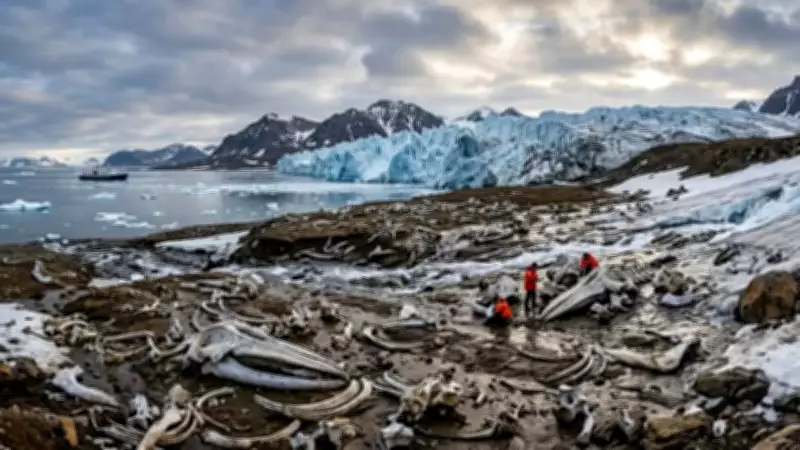
Arctic Glacier Retreat Exposes Ancient Whale Graveyard on Remote Russian Island
The accelerating retreat of Arctic sea ice is unveiling extraordinary scientific opportunities, with researchers now gaining unprecedented access to Earth's marine history through newly exposed fossils. On Wilczek Island, located within the remote Franz Josef Land archipelago, scientists have documented the rapid melting of a Russian glacier adjacent to the island, revealing an extensive graveyard of prehistoric whales.
Discovery During Arctic Floating University Expedition
The remarkable graveyard was discovered during the Arctic Floating University 2025 expedition. These subfossil remains have been preserved within the cryosphere's active layer for thousands of years, offering vital information about ancient sea-level changes and cetacean migration patterns between regions. The Arctic and Antarctic Research Institute (AARI) is utilizing these findings to reconstruct both environmental phenomena with greater accuracy than ever before.
As glaciers continue melting at unprecedented rates, this biological record of ancient marine life presents a unique opportunity to study how marine ecosystems responded to past environmental changes. While scientifically valuable, the circumstances of this discovery are ultimately sobering, highlighting the dramatic transformations occurring in polar regions.

Documenting Unusual Ice Retreat Through Satellite Imagery
Researchers at AARI have meticulously documented the rate of ice retreat on Wilczek Island using archival satellite imagery, confirming that the glacier has been receding at an unusual and accelerated pace. This ice retreat has exposed a coastal terrace blanketed with the bones of ancient cetaceans.
The whale remains represent not a single mass mortality event, but rather a stratigraphic accumulation of numerous animals over thousands of years. Scientists believe this fossil accumulation resulted from a combination of shifting shorelines and marine animals becoming stranded in a shallow bay environment.
Glacial Stability's Crucial Role in Bone Preservation
The Arctic is currently experiencing warming at two to three times the global average rate, a phenomenon known as Arctic Amplification. According to the National Snow and Ice Data Centre (NSIDC), terrestrial ice sheets and permafrost are undergoing accelerated melting, serving as frozen archives for organic and biological materials.
The preservation quality of whale bones depended significantly on their proximity to the glacier's stable, frozen interior. Bones regularly subjected to freeze-thaw cycles near the coast showed considerably greater degradation compared to those entombed beneath substantial layers of glacial ice.
Revealing Ancient Sea-Level Changes Through Skeletal Evidence
Geologists and paleontologists analyzing the skeletal remains conclude they indicate an extremely rapid relative sea-level fall toward the end of the Holocene Era in the northernmost Eurasian archipelago. Research published through UNESCO's Intergovernmental Oceanographic Commission and other global monitoring agencies demonstrates that high-latitude discoveries like this are crucial for calibrating models of post-glacial rebound.
Post-glacial rebound refers to the rising of land after melting ice caps reduce their weight, stranding marine organisms on emergent coastal terraces that gradually rise to become elevated land surfaces.
Climate Implications and Ongoing Monitoring
While this scientific discovery represents a breakthrough for researchers, it also carries significant climate implications. The degradation of ancient organic carbon could trigger positive climate feedback loops. Research archived by the National Oceanic and Atmospheric Administration (NOAA) suggests that thawing permafrost might release dormant organisms and greenhouse gases that have been trapped for millennia.
The AARI team continues monitoring thermometric boreholes in the area to track how rapidly deep-soil temperatures are changing and assess the stability of the Arctic passage. This ongoing research will help scientists understand both the historical record being revealed and the contemporary changes affecting one of Earth's most vulnerable ecosystems.






