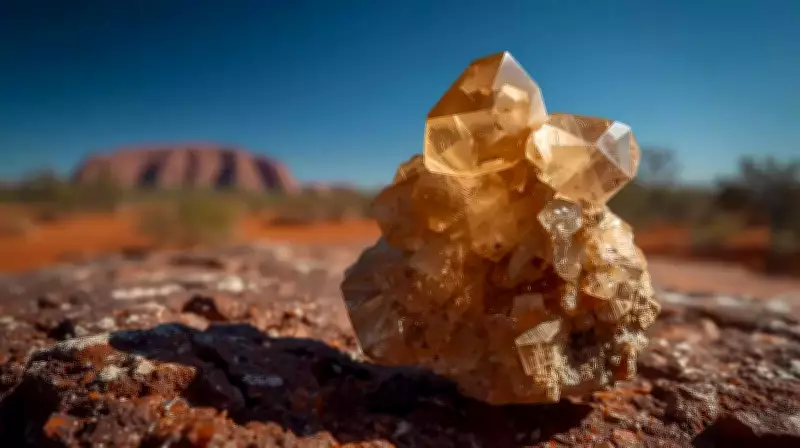
Ancient Australian Zircons Reveal Complex Early Earth Formation Story
Geologists worldwide are turning their attention to remarkable mineral specimens discovered in Western Australia that are providing unprecedented insights into our planet's earliest chapters. These ancient crystals, known as zircons, have been recovered from the rugged terrain of the Jack Hills region and carry an astonishing age of more than four billion years. As the oldest known minerals on Earth, these tiny time capsules are offering scientists crucial evidence about the conditions that prevailed during our planet's formative era.
The Oldest Minerals on Earth
According to the comprehensive study titled "Contemporaneous mobile- and stagnant-lid tectonics on the Hadean Earth," the Jack Hills area in Western Australia has yielded zircon crystals dated to approximately 4.4 billion years old. Considering that Earth itself formed roughly 4.5 billion years ago, these mineral grains originate from an exceptionally early period in planetary history. The survival of these zircons is particularly significant because most rocks from that distant epoch have been destroyed by intense heat and pressure deep within the Earth's interior.
Zircons possess remarkable chemical stability and physical durability, allowing them to withstand geological processes that obliterated other materials. Each crystal is minuscule, typically no wider than a single grain of sand, yet within their microscopic structures, they preserve chemical signatures from the magma in which they originally formed. Scientists employ the well-established uranium-lead dating method to determine their precise age, a technique that has been rigorously tested across numerous rock types and geological contexts.

Chemical Clues to Early Crust Formation
Recent analytical studies have focused intensely on trace elements contained within these Australian zircons. Sophisticated measurements of hafnium isotope ratios, combined with precise oxygen analyses, indicate that some of the magma involved in their formation interacted with both water and older crustal material. This discovery carries profound implications for our understanding of early Earth conditions.
If water existed in substantial quantities during this period, it suggests that certain regions of the young Earth were significantly cooler than previously assumed. Many researchers interpret this data as compelling evidence that continental crust began forming much earlier than conventional models proposed. While the crystals do not provide a complete picture of Earth's early history, they strongly hint at surface material recycling occurring within just a few hundred million years of planetary formation.
This emerging understanding directly contrasts with older scientific models that depicted the young Earth as predominantly molten for an extended geological period. The new evidence suggests a more complex and dynamic early planetary environment than previously imagined.
Evidence Points to Possible Early Tectonic Activity
A significant number of the Jack Hills zircons contain distinctive chemical patterns that resemble those found in modern regions where tectonic plates interact. In contemporary geological settings, subduction zones produce specific magma types that leave recognizable elemental signatures, and remarkably similar signals appear in some of these ancient mineral grains.
This discovery does not definitively prove that modern-style plate tectonics operated exactly as it does today. Conditions on early Earth were likely substantially different, with higher internal heat driving geological processes. Nevertheless, the accumulating data has prompted some scientists to propose that limited tectonic processes may have begun operating very early in Earth's history.
Other ancient zircons from different geographical regions show alternative chemical patterns linked to volcanic plumes, suggesting that early crustal behavior may not have been uniform across the planet. This variation indicates a more complex geological narrative than previously understood.

The scientific debate continues to unfold quietly within research journals and academic conferences worldwide. For the present moment, these small but extraordinarily significant Australian minerals remain central to discussions about Earth's formation, offering tantalizing fragments of evidence rather than complete answers to longstanding geological questions.