Ahmedabad's Pigeons Uncover Hidden Urban Pollution Crisis
In the bustling neighborhoods of Prahladnagar and Bodakdev, blue rock pigeons have become such a common sight that residents often overlook their presence. These birds settle on balcony railings of apartment complexes and perch atop water tanks of residential towers, typically viewed as nothing more than a morning nuisance to be shooed away. However, groundbreaking scientific research now demands that we pay closer attention to these urban dwellers, as they are silently revealing a significant environmental threat.
Pigeons as Living Pollution Detectors
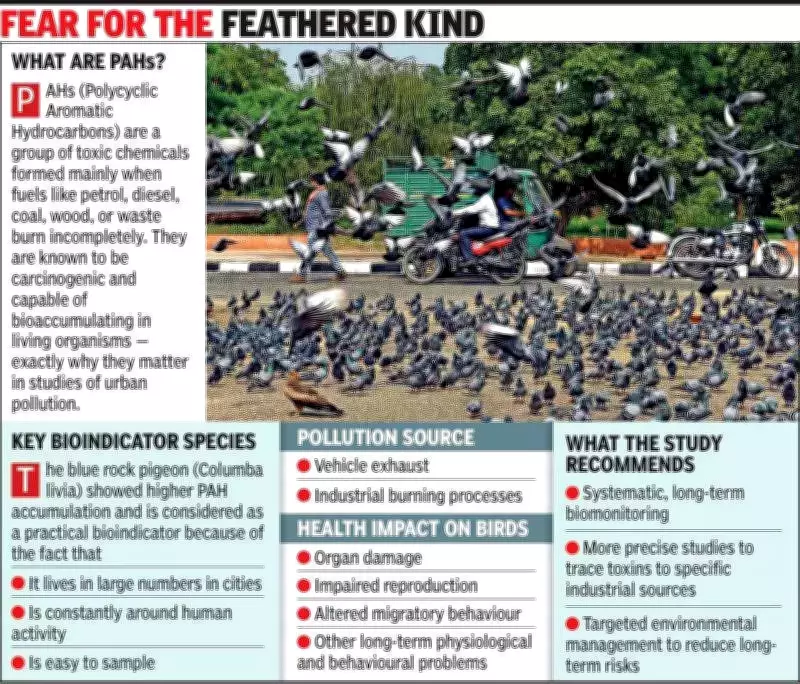
A comprehensive new study conducted by researchers Kanthan Nambirajan and Subramanian Muralidharan has uncovered that Ahmedabad's pigeons are absorbing toxic emissions from vehicles and industrial facilities directly into their tissues. The research, performed at the prestigious Salim Ali Centre for Ornithology and Natural History, demonstrates how these birds serve as practical bioindicators for urban contamination.
The study examined 37 birds across six different species, revealing alarming patterns of chemical accumulation. According to the findings, polycyclic aromatic hydrocarbons (PAHs) – recognized environmental threats due to their carcinogenic and mutagenic properties – are accumulating in urban bird populations at concerning rates.

Toxic Chemicals Identified in Avian Tissues
The research paper, scheduled for publication in Elsevier's March 2026 edition of Science of The Total Environment, details specific chemical compounds detected in the birds. Naphthalene was found in 100% of tested specimens, while phenanthrene appeared in 93% and fluoranthene in 46% of the birds examined.
"Polycyclic aromatic hydrocarbons pose significant environmental threats because of their carcinogenic nature, widespread distribution, and potential for bioaccumulation," the study states. "The pigeon, given its abundance in urban environments and close association with human activity, may serve as a practical bioindicator for PAH contamination."
A Slow-Motion Environmental Crisis
While the detected chemical concentrations remain below immediate toxicity thresholds, researchers emphasize their consistent presence across multiple species indicates chronic exposure. This represents what the authors describe as a "slow-motion" environmental crisis unfolding in urban areas.
The study notes that current analytical methods for identifying pollution sources were originally developed for non-living environments like soil or water. "Further studies are required to confirm source attribution," the report cautions, highlighting the need for more specialized research approaches for living organisms in urban ecosystems.
Implications for Urban Environmental Monitoring
This research opens new possibilities for environmental monitoring in rapidly urbanizing cities like Ahmedabad. By utilizing common urban birds as bioindicators, scientists can track pollution patterns more effectively and identify contamination hotspots that might otherwise go undetected.
The study's findings underscore the interconnectedness of urban ecosystems, demonstrating how pollution affects not just human populations but also the wildlife that shares our urban spaces. As cities continue to expand and industrialize, such research becomes increasingly vital for developing effective environmental protection strategies and maintaining urban ecological balance.