A damning new analysis reveals that air pollution remains a severe and widespread public health crisis across Haryana. Data for 2024 shows that a staggering 98% of the state's towns failed to meet the national annual standard for PM2.5, the most harmful microscopic pollutant.
Only Two Towns Breathe Easy
According to satellite-based estimates by the Centre for Research on Energy and Clean Air (CREA), of the 80 towns assessed, a mere two—Palwal and Ferozepur Jhirka—recorded annual average PM2.5 concentrations within the safe limit of 40 micrograms per cubic metre (µg/m³). The remaining 78 were classified as 'non-attainment' areas, meaning they persistently breach the prescribed norm.
"With nearly 98% of towns still breaching PM2.5 limits, the data suggests Haryana remains far from meeting national clean air targets, even as incremental improvements show up on paper," said CREA's India analyst, Manoj Kumar, in a statement to the Times of India. He emphasized that the year-on-year data confirms this is not a temporary spike but a persistent pattern across districts, affecting major National Capital Region (NCR) cities and smaller towns alike.

Gurgaon and NCR Hotspots: A Persistent Problem
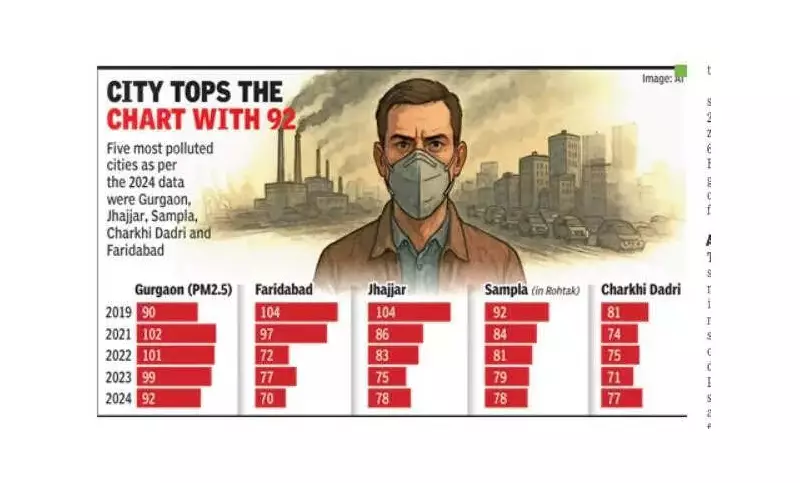
The data paints a grim picture for Gurgaon, a major economic hub. Its PM2.5 levels have remained alarmingly high for five consecutive years. The annual average was 90 µg/m³ in 2019, which soared to 102 in 2021. While there has been a marginal dip to 92 in 2024, this level is still more than double the national standard. Experts attribute this sustained pollution to relentless pressure from traffic, construction, and regional emissions.
Neighbouring towns show a similar, troubling trend:
- Farrukhnagar: Levels hovered between 95 (2019) and 77 (2024).
- Sohna: Fell from 91 (2019) to 76 (2024), yet remained non-attainment.
- Faridabad: Showed one of the steepest declines, dropping from 104 (2019) to 70 (2024). Despite this over 30 µg/m³ improvement, it remains significantly above the safe limit.
Statewide Trends and Structural Challenges
The five-year dataset underscores that Haryana's pollution is a deep-rooted, structural issue. While some districts like Ambala saw clearer declines (from 61–67 µg/m³ in 2019–22 to 43–44 in 2023–24), they still failed to meet the standard. Central and western districts, including Karnal, Hisar, and Rohtak, recorded levels between 55 and 70 µg/m³ in 2024, with only modest improvements.
Notably, some areas have worsened. Sampla in Rohtak district saw its PM2.5 concentration rise from 67 in 2019 to 78 in 2024. Jhajjar town, though improved from 104 (2019) to 78 (2024), remains among the most polluted.
The success stories of Palwal and Ferozepur Jhirka, which saw sharp drops to 36 µg/m³, offer a glimmer of hope. However, experts caution that these gains must be sustained over multiple years to confirm long-term attainment.
The Path Forward: Science-Based Reforms
Analysts stress that piecemeal measures are insufficient. Manoj Kumar of CREA outlined a necessary roadmap: "The only way forward is to strengthen the country's air quality governance through targeted, science-based reforms." Key recommendations include:
- Revising the list of non-attainment cities under the National Clean Air Programme (NCAP).
- Setting stricter emission standards for industries and thermal power plants.
- Allocating funds based on robust source apportionment studies to target major pollution sources.
- Adopting an airshed-based management approach to tackle pollution at a regional scale, transcending city boundaries.
The official ground-based air quality data for 2025 is expected in April, which will provide further clarity on whether the state is making tangible progress against this persistent environmental emergency.