

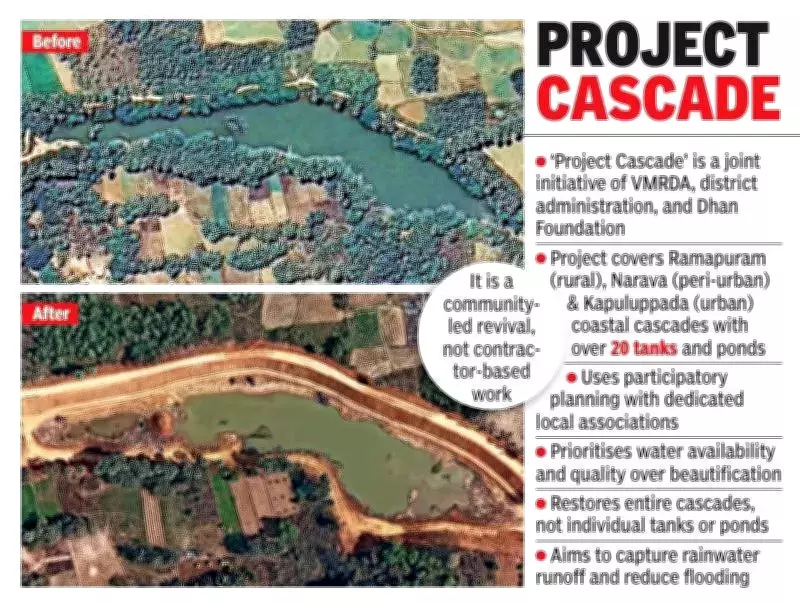
Ancient Visakhapatnam Irrigation Tank Revived After Years of Neglect
In a remarkable conservation achievement, the 1,000-year-old Yerra Banda Cheruvu in Pendurthi mandal of Visakhapatnam has been successfully restored after years of neglect. This traditional irrigation tank, which sustained generations of local farmers, has been brought back to life through a comprehensive community-driven initiative.
From Wasteland to Water Reservoir
The 10-acre tank, once clogged with waste and debris, has been transformed into a functional water body that now holds substantial water reserves. The restoration work has positioned the historic tank to support two to three crop cycles annually while simultaneously reviving local biodiversity, including crucial bird habitats that had been disappearing.
Local farmers are now planning to begin fish cultivation in the restored tank, creating an additional income stream that complements traditional agricultural activities. This diversification represents a significant economic opportunity for the farming community that depends on this water source.

Multi-Agency Collaboration and Funding
The ambitious restoration project was funded by the Visakhapatnam Metropolitan Region Development Authority (VMRDA), with crucial support from the district administration, irrigation department, and various other governmental agencies. The implementation was carried out by the DHAN Foundation under their broader 'Project Cascade' initiative, which focuses on community-based restoration of water bodies across the Visakhapatnam region.
Lokesh Sinram of DHAN Foundation explained that the revival combined advanced technological approaches with grassroots engagement. "We utilized remote sensing technology alongside comprehensive ground surveys and sustained farmer engagement throughout the process," Sinram stated. "Approximately ten consultations were conducted to build trust and collaboratively design the interventions."
Comprehensive Restoration Work
The restoration process included several critical components:
- Extensive desilting operations to remove accumulated sediment
- Removal of invasive plant species that had overtaken the water body
- Strengthening and reinforcement of the tank's bund (embankment)
- Reconstruction of inlet channels to ensure proper water flow
A defining strength of the project was the deep community participation that characterized every phase. Farmers actively negotiated machinery rates, reclaimed disputed land parcels, and formed a local committee to oversee the restoration work and ensure its quality and sustainability.
Community Transformation and Future Maintenance
Reddy Ramana, treasurer of the Yerra Banda Cheruvu Vayalaga Sangam, expressed the community's astonishment at the transformation. "Farmers once believed this tank was beyond repair and had given up hope," Ramana explained. "Today, we can hardly believe it has returned to its pristine state. We extend our gratitude to the VMRDA, district collector, and DHAN Foundation for making this possible."
Sinram added that interest generated from the community fund will be specifically earmarked for future maintenance of the tank. "This project represents more than just a restored water body," he emphasized. "It demonstrates that empowered communities can deliver sustainable solutions to complex challenges involving water security, livelihoods, and ecological restoration."
Broader Implications for Water Conservation
The success of Yerra Banda Cheruvu forms part of the broader 'Project Cascade' initiative, which promotes community-based restoration of traditional water bodies throughout Visakhapatnam. This approach combines technological innovation with traditional knowledge and community ownership, creating a replicable model for water conservation in similar contexts across India.

The restoration not only addresses immediate agricultural needs but also contributes to groundwater recharge, flood mitigation, and climate resilience in the region. As water scarcity becomes an increasingly pressing concern, such community-driven initiatives offer promising pathways toward sustainable water management that honors traditional systems while incorporating modern conservation techniques.





