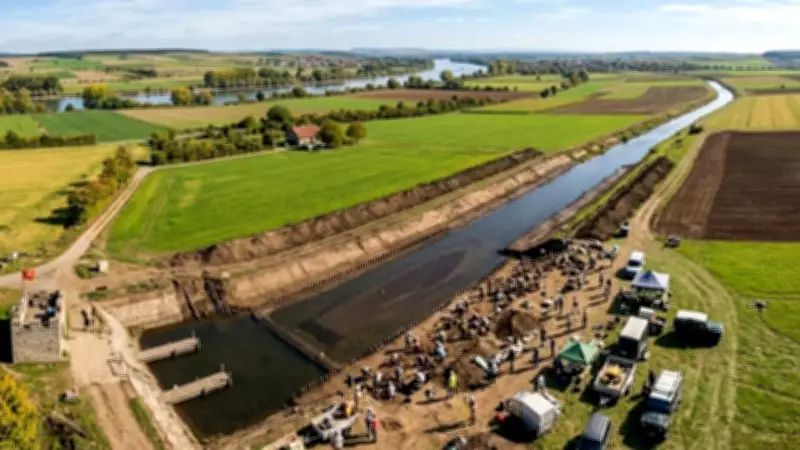
Ancient Roman 'Superhighway' Canal Unearthed in German Farmland
In a groundbreaking archaeological discovery, researchers have identified a massive, engineered canal in the Groß-Gerau region of Germany. This artificial waterway, measuring an impressive 15 meters in width, dates back to the 4th century during the reign of Emperor Valentinian I. The find was made using advanced geophysical remote sensing techniques, revealing a sophisticated structure that served as a high-speed military logistics route.
Strategic Military Logistics and Engineering Marvel
The canal was specifically designed to facilitate rapid movement between the Rhine River and the Fortified Landing Station at Trebur-Astheim. Its primary purpose was to bypass the unpredictable and winding curves of the ancient Rhine, enabling swift transport for Roman patrol boats and heavy freight vessels. This strategic infrastructure was part of a larger defensive program initiated by Emperor Valentinian I to secure the empire's borders against Germanic tribal threats.
Unlike many other Roman ruins, this canal exhibits evidence of continued use and maintenance long after the fall of the Roman Empire. Core samples and soil analysis confirm that it was not a repurposed natural stream but a meticulously engineered trench with a flat bottom and sloped banks. These features were tailored to accommodate the draft of heavy freight ships, known as navis oneraria, highlighting the Romans' advanced civil engineering capabilities in Northern Europe.

Post-Roman Maintenance and Historical Significance
Radiocarbon dating of organic materials retrieved from the canal's sediment has provided fascinating insights. The data indicates that the canal remained in use and was actively maintained until the 7th to 8th century AD, serving as a vital transportation route for the Merovingian and Carolingian dynasties. This prolonged usage suggests that such trade routes persisted into the early Medieval period, challenging previous assumptions about the decline of Roman infrastructure.
The discovery, detailed in the journal Land, underscores the canal's role as a Roman 'superhighway' for military and economic activities. It not only connected key strategic points but also demonstrated the empire's ability to manipulate landscapes for tactical advantages. The canal's dimensions—15 meters wide and 2.5 meters deep—further emphasize its scale and importance.
Implications for Roman History and Archaeology
This significant find is set to prompt a reexamination of Roman hydraulic engineering practices and military strategies on the empire's frontiers. Key aspects include:
- The extent to which the Romans could engineer and control their environment for logistical superiority.
- The durability and adaptability of Roman infrastructure, which continued to serve post-empire societies for centuries.
- The role of such canals in sustaining trade and military movements during transitional historical periods.
The canal's discovery near Trebur-Astheim not only enriches our understanding of Roman technological prowess but also sheds light on the interconnectedness of ancient and medieval European civilizations. As archaeologists continue to study this site, it promises to reveal more about the enduring legacy of Roman engineering and its impact on subsequent historical developments.