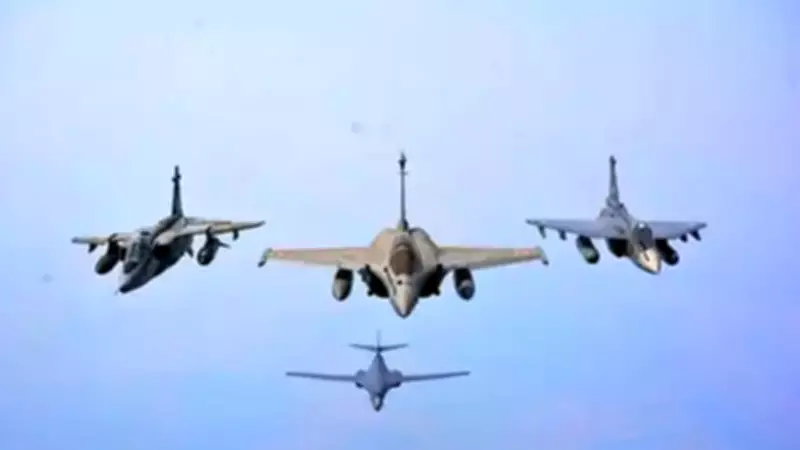
India launched Operation Sindoor, a decisive counter-terror strike targeting terror infrastructure in Pakistan and Pakistan-occupied Kashmir. Precision air, artillery, and drone strikes hit Jaish-e-Mohammad and Lashkar-e-Taiba bases, including their headquarters in Bahawalpur and Muridke. This tri-service operation demonstrated India's resolve to eliminate terror sanctuaries.
Background and Execution
Operation Sindoor was carried out by the Indian armed forces in response to the cold-blooded killing of 26 tourists in Pahalgam, Kashmir. The operation marked a decisive phase in India's counter-terror campaign. It combined precision air strikes with coordinated artillery and drone strikes to dismantle terror infrastructure across Punjab province in Pakistan and Pakistan-occupied Kashmir. The targets represented the operational backbone of groups such as Jaish-e-Mohammad and Lashkar-e-Taiba.
On May 7, 2025, India struck back with carefully selected targets to severely disrupt Pakistan's terror infrastructure. Air Marshal AK Bharti, then Director General of Air Operations, stated: "With absolute clarity of action, a successful joint operation was launched to destroy the terror infrastructure in PoJK as well as in Pakistan itself. And when that first weapon hit the target on the early morning of 7 May 2025, that decisive flash was the strength and the resolve of the people of India being projected into the enemy heartland."

Key Targets
This was the first time the Indian Air Force struck targets in Punjab province of Pakistan. Previously, during the 2019 Balakote air strike, the air force targeted Khyber Pakhtunkhwa. This time, the three services formulated a joint plan to strike multiple terror targets long considered safe havens. The Director General of Military Operations during Operation Sindoor, Lt Gen Rajiv Ghai, said: "Operation Sindoor was also a joint tri-service effort. It integrated land, air and maritime capabilities with shared situational awareness, common operation and intelligence pictures and real-time decision making. Standoff precision strikes, nine in all, seven executed by the Indian Army and two by the Indian Air Force, were timed to perfection, achieved total surprise and inflicted maximum damage in each established hub deep in Pakistan-occupied Jammu and Kashmir and heartland Pakistan, signalling that no sanctuary is safe."
Indian Air Force fighter aircraft destroyed the Jaish-e-Mohammad headquarters at Markaz Subhan Allah, Bahawalpur, and the Lashkar-e-Taiba headquarters in Muridke with missiles. According to the Delhi-based think tank Observer Research Foundation (ORF), the Markaz-e-Taiba in Muridke was hit by Crystal Maze precision-guided munitions, while the Markaz Subhan Allah, deeper inside Pakistan, was struck by SCALP air-launched cruise missiles. Both targets are located in Punjab province.
The next two targets were in Sialkot district of Punjab: terror facilities in Sarjal and Mehmoona Joya. Sarjal served as a logistics hub and safe house, while Mehmoona Joya was a training facility linked to the Pathankot terror attack, as per another ORF report. These two facilities were taken out by the Indian Army.
Sawai Nala, located 30 km from the Line of Control in PoK, functioned as a training establishment for terrorists. Militants who participated in the Sonamarg (2024), Gulmarg (2024), and Pahalgam terror attacks trained there. This facility was hit by the army.
Other terror locations in PoK, such as Barnala, Abbas, Gulpur, and Syedna Bilal, were struck using drones and artillery during the initial minutes of Operation Sindoor.
Strategic Implications
Symbolically, the raid demonstrated India's commitment to destroy terror sanctuaries. The post-strike phase of Operation Sindoor underscores that while kinetic operations have paused, the strategic and psychological dimensions remain active. The dismantling of terror infrastructure has reduced immediate threats, but the information and diplomatic battles continue. The operation demonstrates India's doctrine of precision strikes, escalation control, and narrative dominance in counter-terror campaigns.