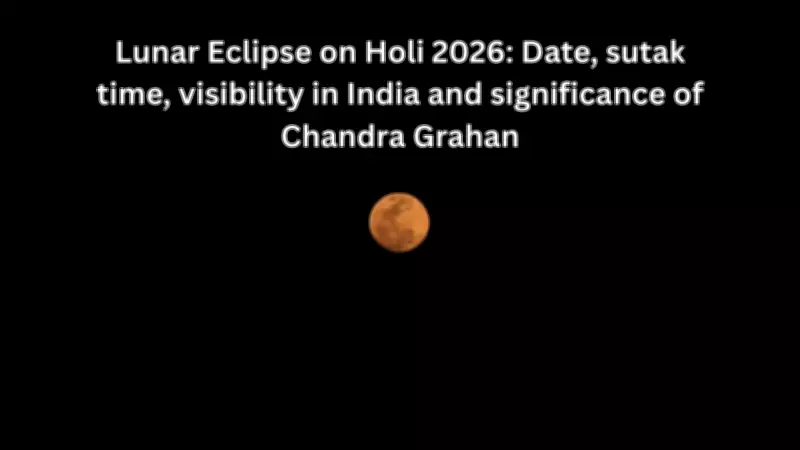
Rare Lunar Eclipse to Grace Holi Festival in 2026
On March 3, 2026, a rare celestial event will unfold as a total lunar eclipse, known as Chandra Grahan, coincides with the vibrant Holi festival. This marks the first lunar eclipse of the year and is considered unique due to its alignment with the festival of colors, offering a spectacular sight for sky watchers and astronomers alike.
What is a Blood Moon and How Does It Occur?
During this event, the Earth will position itself between the Sun and the Moon, casting the Moon into Earth's shadow. This alignment results in a total lunar eclipse, where the Moon takes on a reddish hue. This phenomenon, called a Blood Moon, occurs because sunlight bends through Earth's atmosphere, filtering out blue light and leaving red wavelengths to illuminate the lunar surface.
Visibility and Timing in India
The lunar eclipse will be visible from various parts of India, providing a brief but memorable viewing window. It is scheduled to begin at 3:20 PM on March 3, 2026, and conclude at 6:47 PM, lasting for several hours. However, observers in India will have a limited opportunity to witness the eclipse, with visibility lasting only from 6:30 PM to 6:47 PM after moonrise.

Residents in northeastern states such as Assam, Arunachal Pradesh, Meghalaya, and West Bengal will enjoy a better chance of viewing the eclipse, as the Moon rises earlier in these regions. This makes it an ideal time for photographers to capture the event using DSLR cameras.
Astrological Significance and Holika Dahan
According to astrological traditions, Holika Dahan, a key ritual of Holi, should be performed on March 3, 2026, after the eclipse ends. This is because Bhadra, an inauspicious period, occurs on March 2, making it unsuitable for the ritual. Therefore, it is recommended to conduct Holika Dahan post-eclipse to align with auspicious timings.
Additionally, Sutak Kaal, a period considered inauspicious in Hindu beliefs, will commence at 6:23 AM on March 3 and conclude with the eclipse. During this time, many people observe specific precautions and rituals to mitigate any negative effects, rooted in myths involving shadow planets like Rahu and Ketu, which are believed to disturb lunar energy during eclipses.
Why This Eclipse is Particularly Special
Holi is traditionally celebrated on Phalguna Purnima, the full moon day of the Hindu month of Phalguna. The coincidence of a total lunar eclipse with this festival adds an extra layer of uniqueness, blending celestial wonder with cultural festivities. This rare alignment not only enhances the spiritual significance but also provides a captivating experience for both scientific observers and celebrants.
Overall, the 2026 lunar eclipse on Holi presents a once-in-a-lifetime opportunity to witness a breathtaking astronomical event intertwined with rich cultural traditions, making it a must-see for enthusiasts across India and beyond.