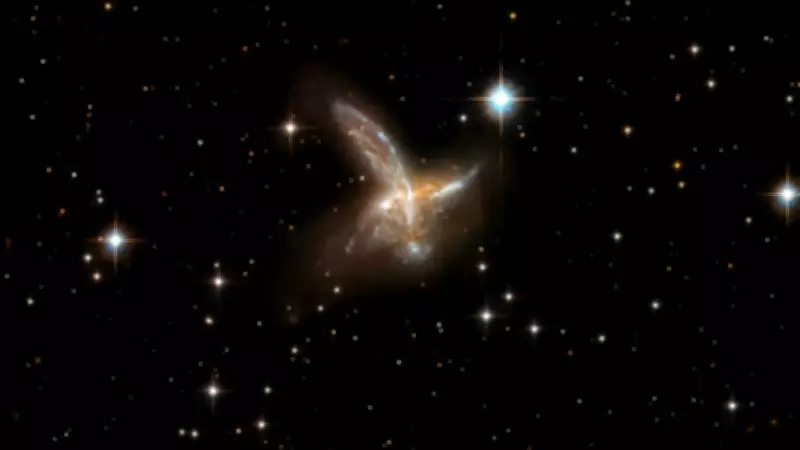
A breathtaking cosmic encounter captured by the Hubble Space Telescope has resurfaced online, reigniting awe and wonder among space enthusiasts. The image, originally taken in 2008, was recently shared on social media platform X by NASA Hubble, showcasing a mesmerizing interaction between two distant galaxies.
A Galactic Dance in Slow Motion
The celestial spectacle features the galaxy system known as ESO 593-8, located approximately 650 million light-years from Earth in the constellation Sagittarius. Unlike violent cosmic collisions, this encounter represents a gradual, gravitational interaction between the two galaxies. Astronomers describe this as one of the most classic examples of galactic encounters ever observed.
The Winged Illusion in Space
In the stunning Hubble image, one galaxy appears elongated and feather-like as it passes through its companion. This creates a remarkable visual effect resembling wings stretching across the darkness of space. The ethereal quality of the image has drawn comparisons to celestial artwork, with the intricate structures highlighting the delicate balance of gravitational forces at play.

Scientific Significance of the Discovery
NASA scientists believe these two galaxies are destined to eventually merge into a single, larger galaxy over cosmic timescales. Such galactic mergers play a crucial role in the evolution of the universe, shaping the formation of stars and planetary systems. The Hubble observation provides valuable insights into these fundamental cosmic processes that have shaped our universe over billions of years.
The Hubble Telescope's Legacy
Named after pioneering astronomer Edwin Hubble, the Hubble Space Telescope was launched in 1990 aboard the space shuttle Discovery. Over more than three decades of operation, with five servicing missions by astronauts, Hubble has revolutionized our understanding of the cosmos. The observatory captures ultraviolet and near-infrared wavelengths, producing iconic images and making over 1.7 million observations that have transformed modern astronomy.
Public Reaction to the Cosmic Marvel
The recent sharing of this galactic encounter has sparked widespread admiration across social media platforms. Viewers have expressed amazement at how natural cosmic phenomena can resemble carefully crafted artwork. Comments range from calling the image "beautiful" to describing it as a "deceptive cartoon for adults." Many have noted that "the universe never stops creating art," highlighting how such discoveries bridge the gap between scientific observation and aesthetic appreciation.
The enduring appeal of Hubble's images demonstrates how space exploration continues to capture public imagination while advancing our scientific knowledge. As NASA's veteran space telescope continues its observations, each new image adds to our understanding of the vast, mysterious universe we inhabit.