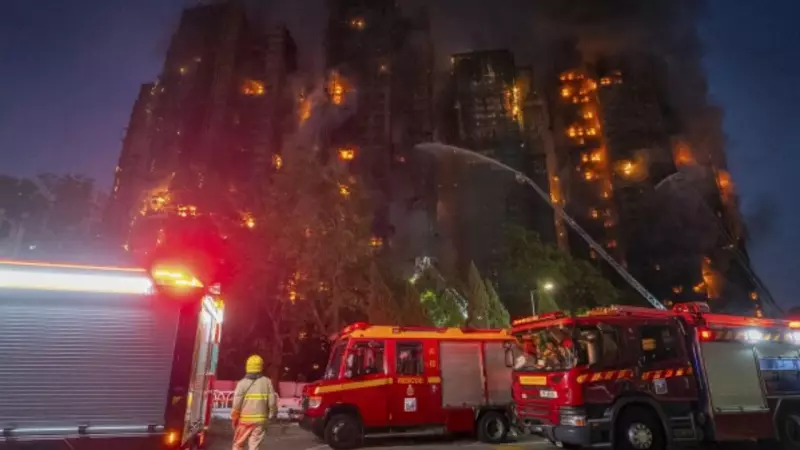
Miracle Rescue After 24-Hour Ordeal in Hong Kong Inferno
In a dramatic turn of events that brought a glimmer of hope to a tragedy-stricken community, fire officials in Hong Kong pulled a man alive from a blazing residential complex on Thursday evening after he had been trapped for more than 24 hours. The rescue came as the death toll from the devastating Wang Fuk Court fire climbed to at least 65 people, marking what authorities describe as the deadliest building fire in Hong Kong in over half a century.
The survivor was located on the 16th floor of Wang Tai House, one of the buildings within the residential complex, according to a fire department update released at 8 pm local time. The rescue operation continues under extremely hazardous conditions, with officials confirming that seventy others have been reported injured, including ten firefighters, while one firefighter is among the deceased.
Emergency Response and Mounting Casualties
Emergency crews have been battling a fire of unprecedented scale and intensity that Hong Kong hasn't witnessed in decades. While firefighters have managed to bring parts of the complex under control, teams on the ground report that the risk of structural collapse and extreme heat inside the buildings has significantly slowed efforts to reach those still missing or stranded.

More than a day after the blaze first broke out around 2:50 pm on Wednesday, thick smoke continued to drift from the remains of multiple high-rise blocks within Wang Fuk Court. Fire officials confirmed that flames have been completely extinguished in four towers, while three more remain under control. The scale of the crisis has required deployment of more than 1,200 firefighters.
In response to the mounting casualties and rising trauma among survivors, Hong Kong Chief Executive John Lee announced the rollout of a "one social worker per household" system to support families affected by the disaster. The administration will also deploy psychologists to provide emotional assistance to help residents cope with loss, displacement and prolonged uncertainty.
Construction Negligence Suspected in Rapid Fire Spread
Authorities continue to investigate what allowed the blaze to spread so rapidly across multiple residential towers. The fire began around 2:50 pm Wednesday before racing up the structure, aided by bamboo scaffolding that wrapped the exterior for ongoing construction work.
In a significant development, police announced on Thursday that two directors of a construction company and a consultant have been arrested on suspicion of manslaughter. Senior police superintendent Lai Yee Chung revealed that foam boards known to be highly flammable had been installed on every floor outside elevator lobbies. Authorities believe the use of such material may amount to "gross negligence."
The tragedy has renewed debate over Hong Kong's widespread use of bamboo scaffolding, a construction practice that authorities last year vowed to phase out in favor of steel. In October, fire officials linked another major blaze in the city's Central district to bamboo frames that fueled rapid flame spread. The Wang Fuk Court disaster is now expected to accelerate regulatory changes already underway.
Community Grief and Ongoing Search Operations
The Wang Fuk Court complex, constructed in the early 1980s, houses roughly 2,000 apartments. With dozens still missing, families spent Thursday scanning photographs of the deceased displayed at shelters set up by city authorities.
Temporary accommodation has been opened in community centers and a nearby school, giving hundreds of displaced residents a place to sleep as the fire response continues. Many survivors reported that warnings never reached their units and they escaped only because they spotted the blaze themselves.
Residents who managed to escape described chaotic scenes with flames racing vertically up the building exteriors, leaving many trapped inside units without alarm or warning. The rescue operation represents the longest and deadliest in decades - and it's not yet over.

More than two dozen people remain missing, officials said late Thursday. Firefighters continue to work floor by floor, often moving only metres at a time as temperatures inside some units remain dangerously high. Equipment limitations have slowed access to upper floors; ladder trucks have only been able to reach half the height of the 32-story towers, far below the level where residents are believed to be trapped.
As rescue teams search for survivors and families prepare for news that may still worsen, Thursday's dramatic extraction of a man from the 16th floor stands as the first major moment of hope in a catastrophe defined by loss. The survivor is reported to be in stable condition, while for countless others, the agonizing wait continues.