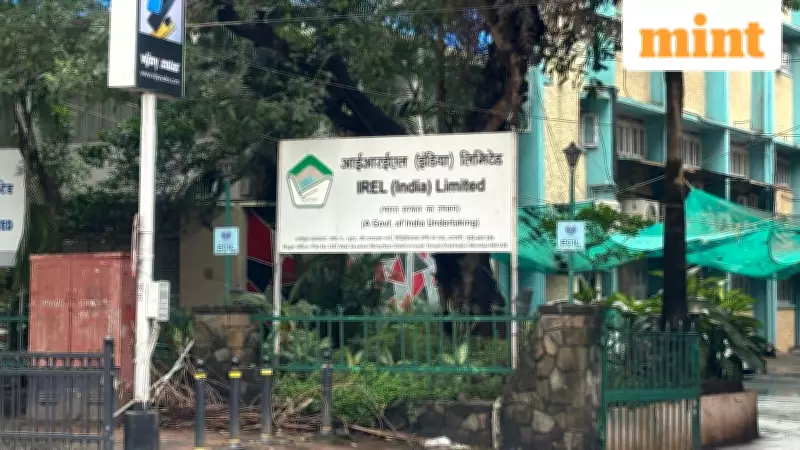
Modest Budget Allocation for India's Sole Rare Earth Producer Sparks Investment Concerns
As India intensifies efforts to localize rare earth supply chains, the government has allocated a modest ₹140 crore in capital expenditure for IREL (India) Ltd, the country's only domestic manufacturer of rare earth magnets and oxides, for the upcoming fiscal year. This represents a mere 1.4% increase from the previous fiscal year's allocation, raising significant questions about whether India is adequately investing in its critical mineral infrastructure.
Stagnant Investment Amid Growing Strategic Importance
The investment funds for IREL, established 76 years ago under the Department of Atomic Science, have remained range-bound between ₹120 crore and ₹140 crore since fiscal year 2024. Notably, actual spending declined to ₹107 crore in FY25, indicating potential implementation challenges. The state-run enterprise does not receive direct budgetary support from the Centre but mobilizes resources through internal and extra-budgetary mechanisms, with budget documents specifying the expected deployment amount for new capital expenditure.
This restrained allocation comes at a particularly critical juncture when China has begun restricting exports of rare earth products, creating supply chain vulnerabilities for multiple Indian industries. Sectors including automobiles and electronics have already experienced component shortages due to limited access to rare earth magnets, highlighting the strategic importance of domestic production capabilities.

China's Dominance and India's Production Constraints
Rishabh Jain, fellow at Council on Energy, Environment and Water, emphasized that IREL possesses rare "mine-to-oxide" capabilities that few global entities outside China can match commercially. However, he noted that domestic demand for rare earth elements due to magnet production is now expected to surpass IREL's current production capacity, necessitating a shift from export orientation to domestic prioritization.
"Scaling up requires not just mining expansion, but significant investment in IREL's downstream separation facilities," Jain explained, highlighting that the company remains the sole authorized processor of monazite, a mineral rich in rare earth elements. The reduction in import duty for monazite sands may provide some short-term relief, but substantial investment in processing infrastructure remains crucial.
Private Sector Initiatives and Broader Ecosystem Development
In the recent Union budget for FY27, Finance Minister Nirmala Sitharaman announced government support for creating four rare earth corridors across Odisha, Tamil Nadu, Kerala, and Andhra Pradesh. This initiative aims to facilitate comprehensive mining, research, manufacturing, and processing activities within India. The announcement follows a ₹7,280 crore scheme launched three months earlier to promote domestic manufacturing of rare earth magnets.
Despite expressions of interest from major companies including JSW, Sona Comstar, Bharat Forge, Proterial, and Midwest Advanced Materials Private Ltd, none of their plans have materialized yet. This leaves IREL as India's only major domestic manufacturer of rare earth oxides and magnets currently operational.
Poonam Upadhyay, director at Crisil Ratings, observed that the strategic emphasis has shifted from entity-specific expansion to building a broader competitive ecosystem. "This is evident in the rare-earth permanent magnet incentive framework, which allocates capacity to multiple qualified beneficiaries through competitive processes," she noted.
Upadhyay highlighted that revenue allocation at the ministry of mines level has increased substantially to approximately ₹3,635 crore for fiscal 2027 from around ₹490 crore in the revised estimate for fiscal 2026. "This signals an early-stage push into critical minerals with clear focus on rare earth elements, aligned with India's Atmanirbhar goals," she added.

Production Capabilities and Environmental Considerations
Originally established as Indian Rare Earths Ltd in 1950 under Prime Minister Jawaharlal Nehru to produce thorium for India's nuclear program, the company has diversified over time. It recently inaugurated a rare earth magnet plant in Vishakhapatnam and currently produces approximately 400 tonnes of rare earth oxides annually, sufficient for manufacturing around 1,200 tonnes of magnets.
IREL maintains a stockpile of about 500 tonnes of rare earth oxides, supporting potential production of approximately 1,500 tonnes of magnets. These components are essential for all vehicles, including both electric and internal combustion engine models. According to a Primus Partners report from August 2025, each electric vehicle requires 1-2 kg of rare earth magnets, with India's demand projected to surge from 1,700 tonnes in 2022 to 7,154 tonnes by 2030.
The company has informed lawmakers that rare earth magnet manufacturing involves substantial costs and requires careful environmental management. In December 2025, the parliamentary committee on public undertakings urged IREL to expedite expansion activities and collaborate with global companies in the rare earth value chain while maintaining environmental safeguards.
IREL responded that due to the strategic nature of its minerals, certain projects concerning national security and atomic energy proceed without public consultations to enable expedited statutory clearances. The company acknowledged that rare earth extraction in India involves complex processes due to radioactive associations, requiring extensive use of water and chemicals while generating potentially toxic effluents.
IREL stated it is obtaining all necessary environmental clearances, implementing technology to reduce effluent toxicity, and adopting new machinery to minimize wastage while increasing recovery rates. However, institutional capacity concerns persist, with questions raised last year about the company operating without a full-time chairman and managing director for nearly twelve months between December 2024 and November 2025.