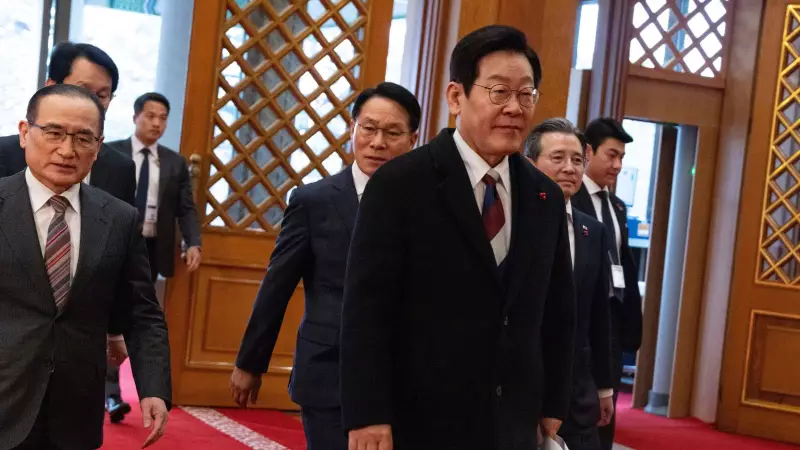
In a symbolic move breaking a decade-long tradition, former South Korean President Lee Myung-bak has stepped back into the iconic Blue House, the nation's presidential palace. This visit marks his first return to the official residence and office since he left power in 2013.
A Decade-Long Absence Ends
The 82-year-old former leader made his notable visit on Tuesday, May 21. His successor, Park Geun-hye, who was impeached and removed from office in 2017, had notably never returned to the Blue House after her presidency ended. This established an informal precedent that Lee's visit has now broken.
Lee Myung-bak served as the President of South Korea from 2008 to 2013. His tenure was followed by that of Park Geun-hye, whose presidency ended in disgrace. The current administration under President Yoon Suk Yeol, who took office in 2022, has made a significant shift by relocating the presidential office from the Blue House to a former defence ministry compound in central Seoul.

The Significance of the Blue House Return
The Blue House, known as Cheong Wa Dae in Korean, holds immense historical and political significance. For decades, it was the nerve center of South Korean power. Lee's return is seen by many as a gesture of reconciliation and a step away from the recent past's political animosities.
Lee Myung-bak himself spent five years in prison after being convicted on charges of bribery and embezzlement in 2018. He received a presidential pardon from Yoon Suk Yeol in late 2022, which restored his political rights. His visit to the now-vacant Blue House complex, which has been transformed into a public park, carries layers of personal and national history.
Official reports state that Lee toured the former presidential residence for approximately an hour and twenty minutes. He was accompanied by Kim Dae-gi, his former chief of staff during his presidency. The visit was facilitated by the current presidential office, indicating a level of official sanction for the event.
Changing Symbols and Political Landscapes
President Yoon Suk Yeol's decision to move the presidential office out of the Blue House was a major political statement, intended to symbolise a break from an imperial style of presidency and to foster greater accessibility. The complex was opened to the public shortly after his inauguration.
Lee Myung-bak's return to this now-public space is more than a simple tour. It is interpreted as a subtle political moment in South Korea's ongoing process of dealing with the legacies of its former leaders. His visit contrasts sharply with the absence of Park Geun-hye, who continues to live privately in Seoul since her own release from prison following a pardon in 2021.
The event underscores the complex relationship South Korea has with its modern political history, where former presidents have often faced legal troubles after leaving office. Lee's walk through the empty halls represents a personal reckoning with a place that once defined his nation's leadership and his own legacy, now reshaped by time and changed circumstances.